Stay Hungry: Helping Startups Commit to Improvement

Let’s say a startup has defied the odds and survived its first several years. The entrepreneur has found a niche market, launched a product, secured funding, and continued to assemble an effective team. The business is moving forward. As the business grows, and entrepreneurs feel they have a safety net where there was none before. But how to stay hungry? Helping startups commit to improvement at every stage has to be the goal.

Staying Hungry: Helping Startups Commit to Improvement.

When things are tough — a startups attitudes and sense of urgency often begin to change. A startups’ attitude changes when they feel that all is well. As the company milestones become less urgent, the intensity of their attention ebbs and start to diminish. This relaxing time is the period when it is most likely to see competitors swoop in and gain market share. Using an improved product offering, or a better customer service, or just a better market strategy might help.

I’ve seen companies come out of the gate and tenaciously follow their North Stars, only to lose focus later on. They start to get comfortable — in some cases, too comfortable. The initial hunger subsides, and employees gradually become less motivated to make the extra effort to drive the company forward.

I implore every company I work with to combat this kind of stagnation by identifying what they can do better at every stage of the company’s life cycle. The critical question is: How do some startups manage to avoid the pitfalls of complacency when others don’t?

Two words: Continuous improvement.

Continuous improvement is valuable at every stage of a company’s life cycle. While it is crucial to set a course for your employees by setting key performance indicators that will ensure the company meets or exceeds its goals, it is equally important to adjust those goals over time as market conditions and customer demands change.

As those goals evolve, it is also critical to stay focused on the company’s best practices to provide a baseline for ongoing changes that can significantly improve growth, profit margins, and retention rates. A constant focus on continuous improvement also helps employees stay intrinsically motivated and challenged, making them less likely to feel stagnant in their current roles.

Progress By the Numbers

Having a reliable way to track progress is key to continuous improvement. Each functional area of your company should have its own KPIs to strive for, each of which should align with your company’s central mission. Choosing the right KPIs is critical — not only will they provide a roadmap for your employees.

But they will also help startups demonstrate to investors that the company is on the right track toward meeting its goals. Management should also ensure that each functional area has its own KPIs that will reinforce broader company goals that can be measured at the individual department level.

Because your goals need to evolve as the company hits various milestones, a KPI dashboard, which show progress toward goals, is a critical way to help teams prioritize their work. For example, if a sales manager shows his team a P&L, balance sheet, and a statement of cash flow, it can be unclear what employees need to focus on next. But if he shows that the customer retention rate is 80 percent when it needs to be at 95 percent, the team can use its KPI dashboard to take action on that data.

Customer needs and behaviors change regularly, but many companies only alter their approaches long after a problem has been identified. To avoid this pitfall, be sure to reexamine your standard processes continuously and to adjust your KPIs with a view to the future. It is always better to get ahead of a problem than to trail behind it with a quick — and potentially ineffective — fix.

Keep an Eye on the Lag and Lead

By documenting standard processes thoroughly and making sure all relevant data remains at hand, management should be able to determine more easily where changes need to be made. To help managers figure out what needs to change (and how), it is useful to turn to lag measures and lead measures.

Generally speaking, a lag measure is retrospective data that is too late to change, such as the previous month’s revenue. A lead measure tells you whether you’re on track to hit a goal in the future. For example, if a company is trying to increase its conversion rates, the lead indicators might be the number of phone calls.

Maybe the problem will be the number of demos that a sales team makes with potential clients. Later, the team would examine the lag measure of the number of demos that didn’t convert. Both measures are key indicators of a company’s progress, and they can inspire procedural changes to help teams meet their goals.

When processes are standardized, a single small change can alter the course of an entire functional area. If everyone isn’t doing things the same way, change becomes more difficult. With thorough, up-to-date documentation, everyone from a new hire to a seasoned manager has something concrete with which to gauge themselves.

At any moment, there can be a downward turn when unexpected obstacles emerge. More importantly, each person has documentation of what worked before showing them a precise roadmap of what needs to go right, which is crucial for continuous improvement.

The Lifeblood of a Startup: Motivated Employees  

Management needs the right data to make informed decisions on how to improve, but employees are the ones who truly move the needle. The manufacturing-era “carrot and stick” method of motivating employees, in which workers are given compensation for jobs done well and penalties for under-performing, no longer works—and it is especially ineffective with millennials.

Extrinsic motivation, in the form of raises and promotions, is also unsustainable. Companies that rely on a purely monetary reward system run the risk of paying their people too much too soon and being unable to retain them as they continue to advance in their careers. Today’s employees need to be motivated intrinsically to do better.

KPI dashboards are a fantastic intrinsic motivation tool. They not only allow employees to track their progress; they also will enable them to pinpoint areas in which they can do better. To improve employee performance at my old company, Affiliate Traction, we developed an online KPI scorecard.

Each employee was given five goals to accomplish, and employees could view each other’s progress toward those goals in a live spreadsheet. This gamification of work caused a noticeable uptick in employee motivation and productivity —and it didn’t cost us a dime.

The most successful companies I’ve worked with have been learning organizations — ones that take the time to figure out what makes them successful, to document those strategies and procedures, and to reassess them as the organization grows.

Employees are far more likely to stay motivated if they are continually learning and growing along with the organization. As with any learning process, mistakes are inevitable. But in my view, mistakes are only failures if you cease to learn from them.

https://samplecic.ch/stay-hungry-helping-startups-commit-to-improvement.html

10 Fabulous Predictions for the Future of Cryptocurrencies

Cryptocurrencies have come a long way since the first Bitcoin which used to buy a couple of pizzas. Few of the people who owned these currencies still have them. But, many who rode the first wave of crypto have been rewarded with an ample amount of money and properties. How about 10 fabulous predictions for the future of cryptocurrencies?

Glimpse of Cryptocurrency and its past history.

It was in the year 2017, cryptocurrencies skyrocketed to the next level. But, the future of Cryptocurrency is still getting plenty of predictions every moment. People from different domains have started looking for these predictions. In December 2017, Bitcoin broke the trading charts by surging up to $20k, and became the most worthy cryptocurrency to the world. 

Even though Cryptocurrencies will impact the future — the regulations will keep getting tighter. Countries like United States, United Kingdom, Australia have accepted Cryptocurrencies. In future, there are chances that other countries will come forward and accept Cryptocurrencies. We are all hoping that countries like – Mexico, Thailand, and South Africa will take the necessary steps to make crypto legal and adopt the Blockchain.

But, what do cryptocurrencies hold for us in the next decade? Here are the 10 fabulous predictions for the future of crypto’s.

Everyone will start to use Cryptocurrencies — and they may not even be aware of it.
Though it has been a decade since the arrival of Cryptocurrencies, there are people who aren’t aware of it. They make use of the traditional method of transactions to manage the money flow. In the future, businesses will start using Cryptocurrencies to pay for their services. With this, businesses will remove the middleman from various processes. And it will reduces costs and makes their services cheaper for the end user. All this will happen even when people aren’t aware of the cryptocurrencies. Bitcoins will hit $1 million.

John McAfee has predicted a very bold thought about Bitcoin hitting $1 million by the end of 2020. He believes that, crypto currencies are the most trusted ones. Once the Bitcoin takes over the global economy, the demand will increase and the traditional dollars will no longer be needed.  

The owner of Snapchat, Jeremy Liew and Blockchain co-founder Peter Smith predicts that by 2030, the price will have reached $500.000.

  • In the future, Bitcoin will act as Remittances for many people.
  • Lack of knowledge can make the people buy Bitcoins as a safer mode of investment similar to Gold.
  • With smartphone transactions, half of the world will march towards non-cash transactions by the year 2030.
  • Cryptocurrencies will replace Fiat currencies.

According to Draper, one of the Crypto Enthusiast has recorded his view on the same. He says Fiat currencies will disappear as people will start marching towards cryptocurrencies like Bitcoin, Ethereum, etc. The major reason for this adoption is people believe cryptocurrencies as the reliable storages of value across country borders and political aspects.  

If you consider the most popular cryptocurrency, Bitcoin, it has reached the top 30 currencies list by passing the $10.000 hallmark. Thus, most of the experts predict Cryptocurrencies are here to stay by being an alternative for Fiat Currencies. Moreover, it is said that the total lifespan of fiat currencies will be at a maximum of five years.

Government Agencies will soon adopt Blockchain Technology.

Countries with SEC Guidelines will start adopting Cryptocurrencies for their Governments. Currently, Government agencies are maintaining a separate database. Each agency is dependent on the other for its processes. This has been a tedious process nowadays. When Blockchain comes into the picture, the distributed ledger can provide effective data management to enhance the process and make it simplified.

In the next ten years, we can expect powerful cryptocurrencies to rule the Governments and manage the cash flow in the country. Crypto enthusiasts predict Government agencies will soon start adopting this Decentralized systems for their processes. For example, the Estonian Government has already adopted Blockchain Technology called X-Road, which stores the complete credentials of all citizens.

Future of Cryptocurrencies will integrate with Internet of Things.

IoT is already here. When both these giants get combined, we can expect a fantastic future of technologies without any doubts. According to the recent report by IDC, it is expected that Blockchain Technology will join their hands with the Internet of Things soon.

The primary motto of the integration is to render a highly scalable and secure framework for communication between IoT devices. Yet another thing is Cryptocurrencies have the stability to make micro-investments for smart devices in an efficient way.

Cryptocurrency Exchanges Trading.

The Trading enthusiasts in the crypto world are marching towards cryptocurrency exchanges for trading. In the near future, more cryptocurrencies will come into existence. With the growth in the price of cryptocurrencies, users will start trading with different currencies.

As Bitcoin is the popular cryptocurrency till the date, Ripple will also emerge to be the next Bitcoin in the future years. Along with this, Ethereum, Litecoin, Stellar will start to uprise their prices. As the price starts rising, it will have a great impact on crypto exchanges and the crypto world.

Banking and Financial industries will undergo disruption.

Blockchain and Cryptocurrencies have a lot to do with Banking and Financial sectors. Banks will eventually accept cryptocurrencies to reduce their complexities. Here are a few things cryptocurrency will do:

  • People will start opening Cryptocurrency Bank Accounts.
  • Cryptocurrency Debit cards will become a normal thing.
  • Instead of withdrawing money, one can buy Bitcoin and other cryptocurrencies directly from ATM’s.
  • Banks will be ready to offer cryptocurrency loans to suitable candidates.
  • Cryptocurrencies will make an instant process.

    Do you want to send money back to your parents living on the other side of the world? It will just require 5 seconds to send your $5000 to them with fewer transaction fees. You don’t need to wait for 3 days to fill their pockets.

    In addition to the fast transactions, Blockchain Technology will bring in the feature of downloading or file transfer within seconds. Blockchain copies of games, music, videos, books will be sent to your cryptocurrency wallets at a higher speed which would eliminate today’s file transfer services.

    New Cryptocurrencies will start emerging.

    Though Bitcoins, Ethereum, Litecoins are ruling the world for now as they are the first Blockchain products invented. Innovations don’t stop here! Most of the new cryptocurrencies will start emerging and the future lies with them.

    These cryptocurrencies will be far different from the present ones. Just imagine a cryptocurrency which can identify the individual’s reputation and lets you in investing in them! Great right? No wonder that we aren’t far away from it!

    Cryptocurrencies will still be volatile.

    Despite the measures to stop volatility, Cryptocurrencies will still implement the factors to eliminate it. The major factors for low volatility are regulation of the country and the markets. But when cryptocurrency trading emerges at its peak, cryptocurrencies would experience a deep feeling of relief.

    Conclusion

    Last but not least, cryptocurrency ventures are on a rise. As their numbers accelerate every day, it will result in widespread adoption. Once they are widely adopted, they can be the next version of the technology in all sectors. With this fact, we can expect the conversion of Cryptocurrencies to currencies very soon. And you can see a lot of Cryptocurrency Development Services have been emerged in recent times for the betterment of Investors who would like to create a foundation.

    https://samplecic.ch/10-fabulous-predictions-for-the-future-of-cryptocurrencies.html

    4 Painless Ways to Pay off Small Business Loans Early

    Paying back small business loans (SBL) has become a nightmare for so many entrepreneurs in this millennial age. The research by Main Street Lender on over 10,000 business loan applicants in the U.S disclosed that about 64 percent of applicants were unable to secure any type of financing. About 82 percent of applicants were denied financing by their bank. There are four painless ways to pay off small business loans early.

    While several factors make it difficult for small business owners to meet their loan payments, there are unconventional ways to pay off you SBL early and with ease. #1 Apply for a loan that doesn’t exceed your current business worth:

    While getting a SBL from a finance company to expand your business is part of your business plan, working towards paying back what your borrowed shouldn’t be left out.

    Interestingly, one of the ways to pay off your small business loan earlier than expected is to apply for a loan within the range of your business worth. For example, if your small scale business worth $4000 and you want to apply for SBL to boost your business growth, it’s pretty much advisable that you apply for a loan within the range of $3000-$4000.

    With the loan within your business worth, you’ll be able to manage and track your business growth much better compared to when you apply for a loan beyond your business worth. For example, if you apply for a loan of $6000—this will not only make you think that your business has already increased but might also feed you with the notion that you have excess to spend.

    If you’re weak in managing your finances, with time, you might end up finding it challenging to pay off your debt.

    Note: The U.S Small Business Administration has emphasized that the success of any business lies in its management. And that poor management of small business loans is cited as the reason behind business failure.

    #2 Invest more on item(s) with high selling power:

    Practically, investing more on item(s) that sells pretty fast in your company/store is not just a strategic way of increasing your business profit. But, it can be a way to pay off your debt earlier, and with ease. How do you spot out the best moving part of your business?

    All you have to do is to study, keep track of both the previous and current sales records of each item sold in your store/company. Let’s say you run a retail store where you sell provisions, toiletries, and vegetables. And the average weekly sales report of each item for the past six months is as follows:

    • Provisions: 345 pieces.
    • Toiletries: 200 pieces.
    • Vegetables: 150 pieces.

    From the above results, you’ll discover that ‘Provisions’ have more selling power than Toiletries. Toiletries have more selling power than Vegetables. Learn early that it is wise to invest a higher percentage of the loan on what is selling the best in this case — provisions. Then use a moderate percentage of the loan on toiletries, and a lesser percentage of the loan on vegetables.

    Thus, this technique ensures the constant availability of items with higher selling power — which will result in more profit.

    #3 Save 20 percent and invest 80 percent of the entire loan into your business:

    Saving 20 percent of the SBL received, and invest 80 percent of the loan into your business. This way of spending is a smart way of preparing for an emergency monthly loan repayments.

    With the saved money (or backup money) you can easily pay up your SBL monthly refund without going through stress — especially during low sales seasons and still, secure your reputation with the lending agency.

    Hence, if sales are friendly enough, it’s advisable to pay off your monthly returns from the money realized through sales and still leave the saved money for the raining day.

    #4 Adopt the two-week half-monthly payment system:

    Several analytical kinds of research have proven the ‘two-week payment system’ to be a reliable technique that clears debt earlier than expected. The Mortgage Report affirms a two-week half monthly mortgage payment system to be a program that short-circuits any loan amortization schedule.

    A two-week, half-monthly payment system is simply a scheduled payment system whereby a borrower pays off half the monthly loan every two weeks.

    Interestingly, instead of you paying off your SBL of $3000 in three-months — you will be paying $1000 every month. You can make up six full payments of $500 in 84 days in this way. This way of payment is less than three months (90 days) using this type of payment system. Thus, the two-week half-monthly payment system has earned you six debt-free days compared to the standard monthly payment method.

    Note: This technique can be used for any form of loan you have or want to apply for.

    Conclusion:

    There is no doubt that the challenge to pay back small business loans (SBL) has become a nightmare for many entrepreneurs, but with the above tips you should be able to make your full payment early, and with ease. Also, you have to be consistent in your payments to guarantee a reliable result.

    Image Creds: vitaly-taranov-145502-unsplash-825×510

    https://samplecic.ch/4-painless-ways-to-pay-off-small-business-loans-early.html

    5 Steps to Creating a UX-Design Portfolio

    The word “designer” can mean many different things and a designer role comes with many possible skills and responsibilities. UX-design portfolios showcase who their owners are: the areas in which they specialize, their strengths, their processes, and their design styles.

    In this article, I refer to a ‘designer’ as anyone who designs one or several components of the user experience — interaction flows, discrete interface elements, visuals, or omnichannel journeys, whether on a desktop, a touchscreen, or on some other device.

    Many of our top 10 recommendations for UX-research portfolios also apply to design portfolios. A common misconception about design portfolios is that they are only made up of final UI designs and screenshots. This article will guide you through the steps of creating a UX-design portfolio that encompasses your entire UX process and not just the shiny artifacts.

    What Hiring Managers Are Looking For

    As part of our current research on user-experience careers, we surveyed 204 UX professionals in charge of hiring about what they look for in a portfolio. Here are some things they mentioned:

    • “Show me how you started with an opportunity and produced real value for a user and the organization.”
    • “I’m curious to know what isn’t in the design and why, just as much as I’d like to know why elements made it in.”
    • “Don’t just show me the finished product. I want to see the messy process and all the work and research that was put in to land on that shiny polished design. Tell me the problem you were trying to solve, your role, any constraints, project timeline, changes from iteration to iteration and how the research informed the design.”

    The “users” of your portfolio will be hiring managers, recruiters, or fellow UX professionals, so your portfolio must appeal to these different groups of people. Think about which capabilities you want to showcase and how each group will understand this information. Very rarely will hiring managers take the time to read your entire portfolio word for word — which is one reason why your portfolio should be scannable and not contain unnecessary detail.

    Before designing your portfolio, prioritize what you want to communicate. What are the top three things about you and your work that a reader of your portfolio should take away? Revisit this question once your portfolio is completed to make sure you achieved your goal.

    Putting It Together Step 1: Take Inventory of All Your Projects

    UX professionals work on many types of projects and tasks. Therefore, it may be difficult to narrow down what to include in a portfolio. The first step is to take inventory of the projects you’ve worked on.

    You’ll want to showcase your specialties through multiple types of work. To do this, consider all your projects and ask yourself the following questions:

    • What am I really good at?
    • Which UX activities do I really like to do?
    • What differentiates me from other designers?
    • On which projects did I bring the most value?
    • From which projects did I learn the most?
    • What interesting stories can I tell about the work that I did?

    Prioritize projects that align to the work you’re looking for. When seeking a new job, tailor your project selection to the job duties you want to perform. For example, if you really enjoy prototyping, showcase projects where you created prototypes and how they benefited the ultimate outcome. You don’t want to promote work that you don’t like doing, so be sure to avoid adding in projects that don’t align with your future career goals.

    Step 2: Choose 3–5 Projects as Detailed Case Studies

    Quality over quantity is the best rule to follow when putting together your portfolio. Since hiring managers don’t have a lot of time to dedicate to each candidate’s portfolio, it’s best to choose a few of your best projects to showcase from your prioritized list you made in the previous step. The projects you choose should align to the work that is described in the job description.

    The number of projects you include is not important per se. What’s important is that your portfolio showcases a wide variety of work and skills — so, if you had substantial, varied contributions to a small set of big projects, emphasize the many different activities that you were involved in. 

    In addition to visuals for each project, create a case study that includes the following information:

  • The problem(s) you had to solve or the hypothesis you came up with for solving it
  • Example: Our application got negative reviews because users weren’t receiving alerts about new sales on the site. Based on the content of the reviews, we hypothesized that users were not aware that they could adjust notification settings in the application.
  • Your specific role in the project and how you collaborated with others
  • Example: I was the sole UX designer on an Agile team comprised of 3 developers, a product owner, a scrum master, and a quality engineer. I was responsible for determining the overall design direction of the project, while collaborating with the rest of the team on ideation.
  • How you came to your proposed solution(s)
  • Example: Usability testing showed that users did not realize that they could adjust their notification settings. We decided to design the notification settings to be more prominent in the site navigation.
  • How your proposed solution(s) solved the problem
  • Example: We conducted additional usability testing with the same tasks and our new design, which showed an increase in findability compared to the previous round of testing. Users were able to adjust their notification settings, which gave them access to new sales alerts.
  • Challenges you faced, including design concepts that were ultimately not pursued
  • Example: During ideation, we went through several different design concepts that ultimately did not completely satisfy user needs. One design concept that we prototyped displayed the notification settings in a modal when users logged in, but it caused frustration because people had to close it to complete their original task.
  • How the project affected the users and the business
  • Example: Because users were now able to turn on new-sales notifications, sales increased by 15%. Our application reviews have skewed positive and customer-satisfaction survey scores have increased.
  • What you learned
  • Example: Because of this project, we realized the importance of prototype testing for exploring new design concepts. It made us test new designs to make sure they were viable solutions before putting in development effort.
  • These case studies should be displayed in a way that is scannable and easy to follow. Include relevant photos and screenshots that tell the story, including early sketches, whiteboards, research documentation, or final images.

    Remember, the final screenshots only tell part of the story. Hiring managers want to understand how you work and giving them a glimpse of your process will help them envision how you fit in with their teams.

    Step 3: Choose Your Desired Format

    Regardless of format, your portfolio should tell a story. Break up text with visuals and make a clear distinction between projects.

    There are three common formats for designer portfolios:

    Web-Based

    A web-based portfolio is a website or online service that displays your work. Web-based portfolios are the most common medium for designers. Resist the urge to go overboard on a flashy template. Your content should be the main focus and your site should be easy to navigate and consume.

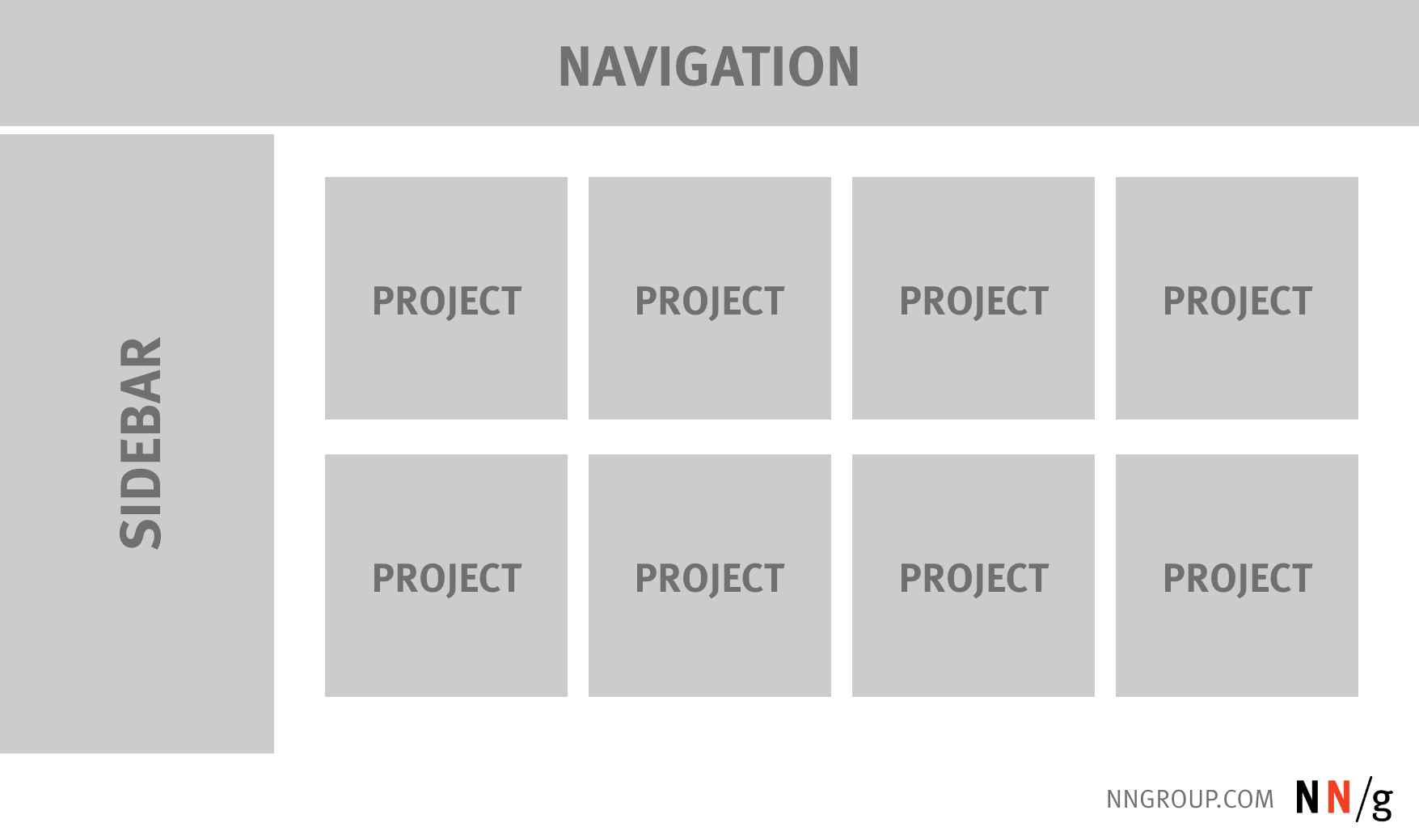
    5 Steps to Creating a UX-Design Portfolio A typical web-based portfolio has some form of navigation along with a collection of projects. Users are able to click each project individually to learn more about it.
    PDF / Slide Deck

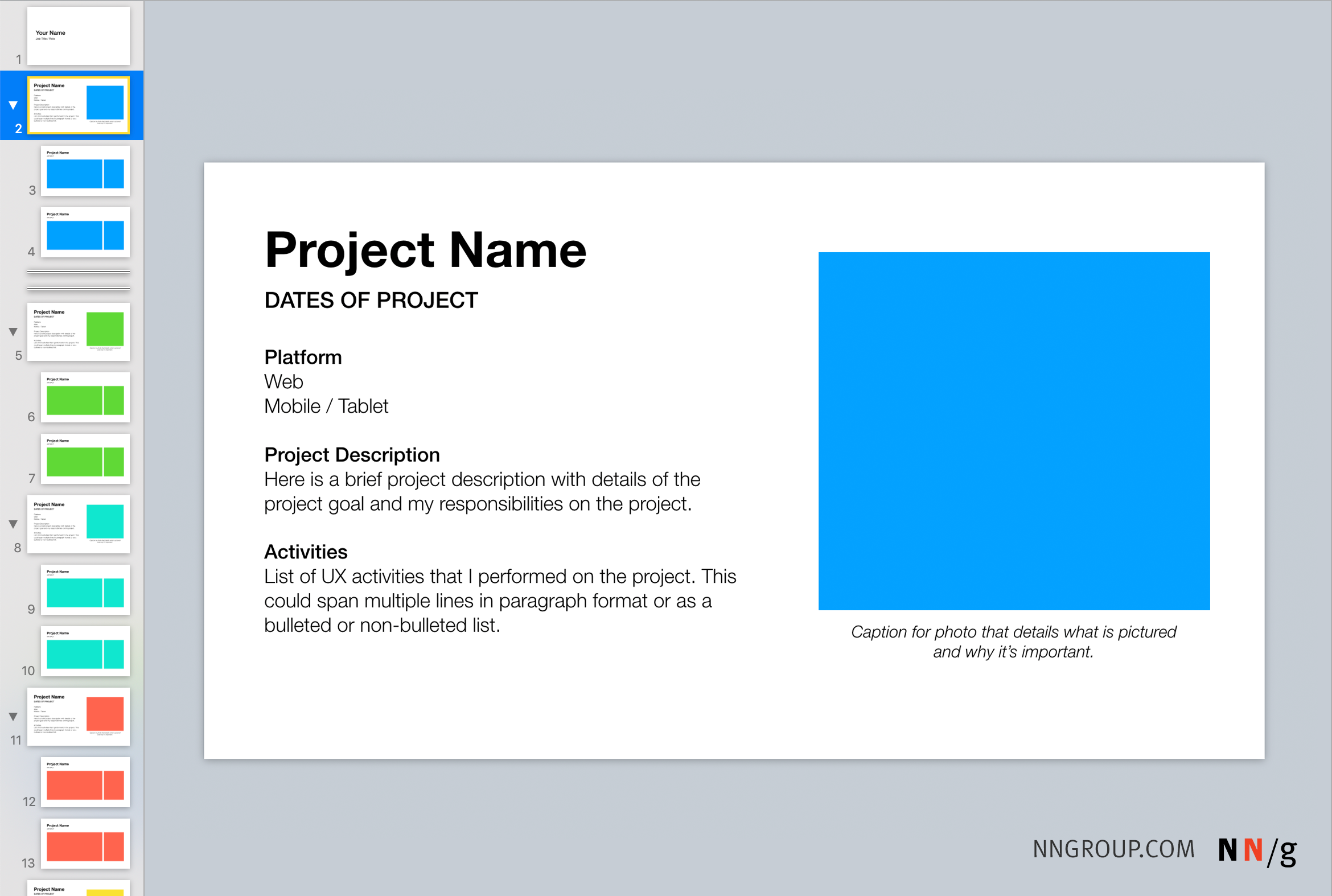
    Another popular medium for portfolios is a digital PDF or slide deck, which acts as a presentation of your projects. When creating a digital portfolio, keep a master PDF or slide deck with all of your projects included so you can hide projects depending on the job you’re applying for or the skills you want to highlight.

    5 Steps to Creating a UX-Design Portfolio Keeping a PDF portfolio based on a slide deck allows you to tailor the projects you show to different audiences. Simply hide the projects that are not relevant to the job.
    Physical Artifacts

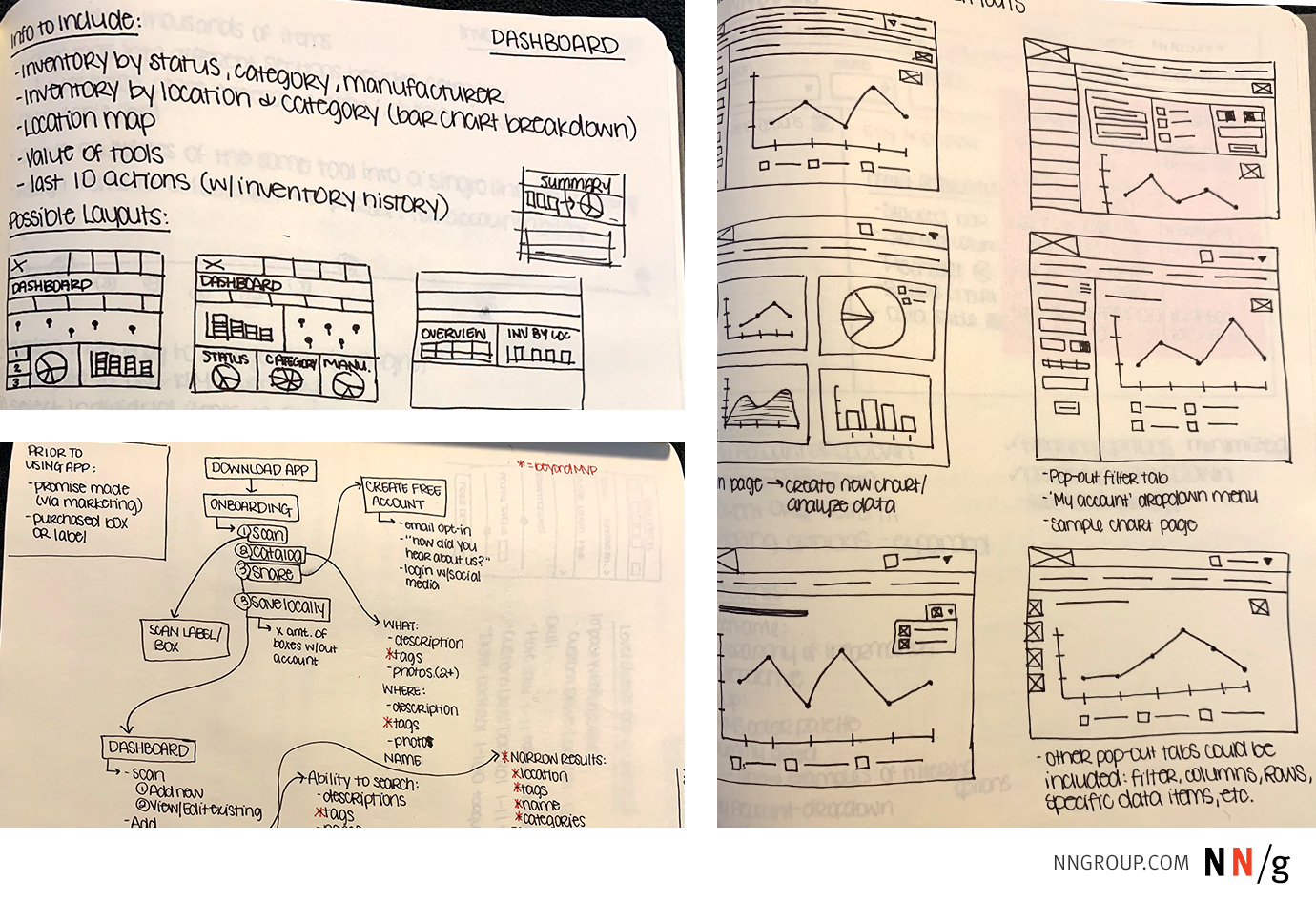
    Physical portfolios are more common with print designers, but you can bring physical artifacts that you use during your design process — such as sketches or paper prototypes — into an interview. Couple your physical pieces with either a web-based or PDF portfolio so that hiring managers can see your work prior to an interview.

    5 Steps to Creating a UX-Design Portfolio Physical artifacts allow you to show rough sketches and process diagrams, including design options that didn’t make it to the final product.
    When deciding between formats, ask yourself the following questions:

    • Did the hiring manager specify a format?
    • What costs are associated with this format?
    • How much knowledge do I have of the software that I’ll be using?

    If the answer still isn’t obvious, below are some pros and cons of the possible formats.

    Medium

    Pros

    Cons

    Web-based

    Easy for hiring managers and UX professionals to find and view organically


    Many options for setup that don’t require coding knowledge

    More difficult to tailor your portfolio to different job types


    May force you to adapt your info to a predefined template

    PDF / slide deck

    Allows you to have multiple unique, job-tailored portfolios 

    Harder to access (e.g., may have to be explicitly shared with the hiring manager)

    Physical artifacts

    Can be brought along to interviews to help you talk through your process

    Very limited access, hard to share with hiring managers

    Step 4: Create Your Portfolio

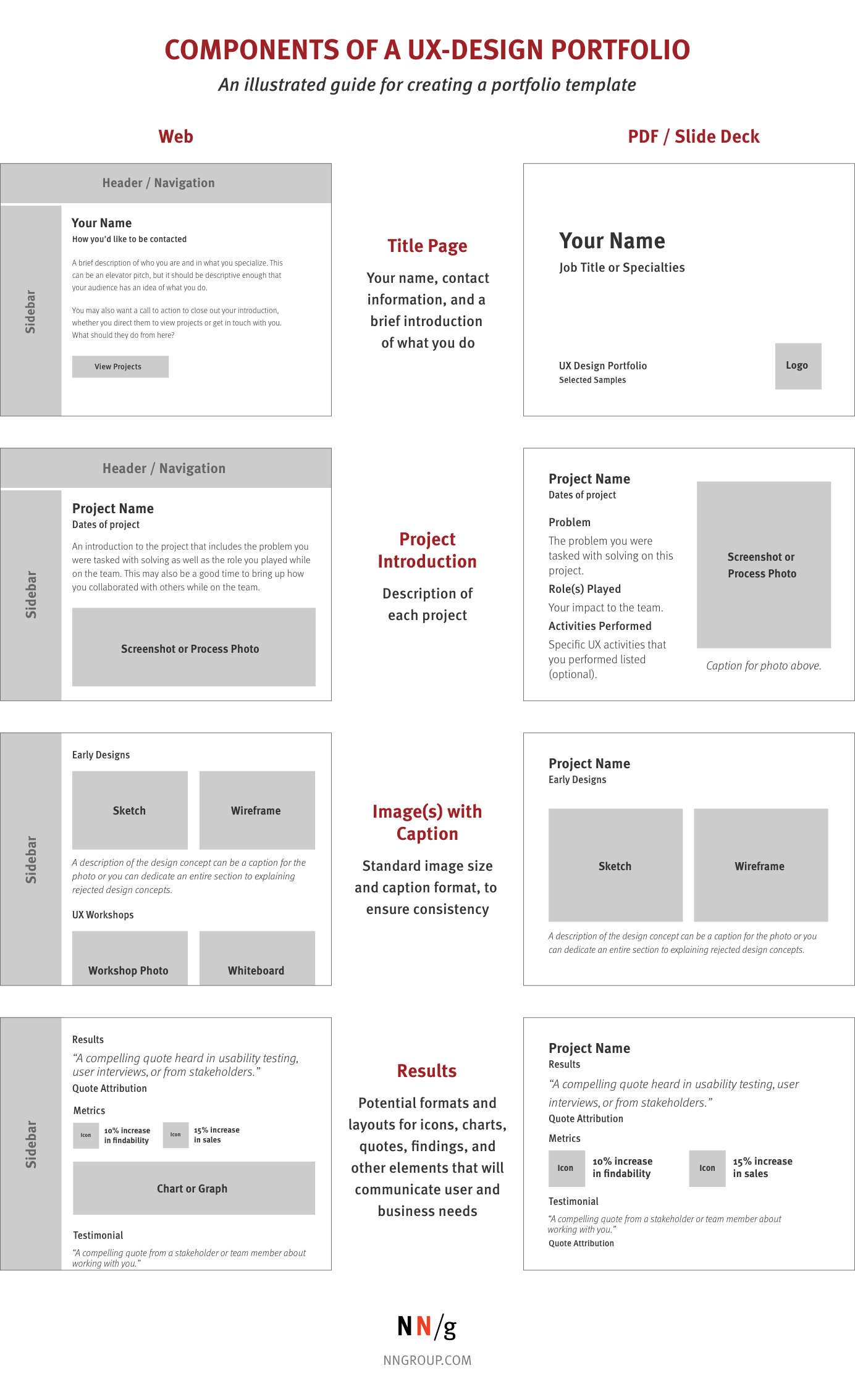
    Now that you have a plan for your projects and format, you can start putting everything together. Regardless of which format you’ve chosen, create a basic template that you’ll follow so that all of your projects look cohesive.

    5 Steps to Creating a UX-Design Portfolio Example templates for the 5 basic components of a UX-design portfolio: title page, project introduction, images with captions, and results Step 5: Get Feedback and Iterate

    Once your portfolio is created, send it to others to provide feedback. Another set of eyes on your portfolio will catch spelling or grammar errors, confusion about content, and the overall usability of your format.

    As you interview with hiring managers, make note of what resonates with them and what is unclear. Then iterate on your portfolio.

    As you work on new projects going forward, save any artifacts or process documents to use as future case studies in your portfolio. Your portfolio will always be a work in progress and having an efficient method for keeping track of projects will make updates simple.

    Navigating Roadblocks “My work is under a nondisclosure agreement (NDA).”

    Nondisclosure agreements are common when doing UX work — and even more so if you’re doing government work. These contracts prohibit you from displaying identifying information about the company, its users, or the project details. Restrictions can be frustrating when you’re crafting your portfolio, but there are ways to show your work without violating the NDA.

    Show process images. Rather than showing the polished UI and visual designs that display company-specific information, showcase your process for these projects. Highlight communication skills like workshop facilitation or early design concepts through sketches or black-and-white wireframes.

    5 Steps to Creating a UX-Design Portfolio Workshop photos give potential employers insight into your design process.
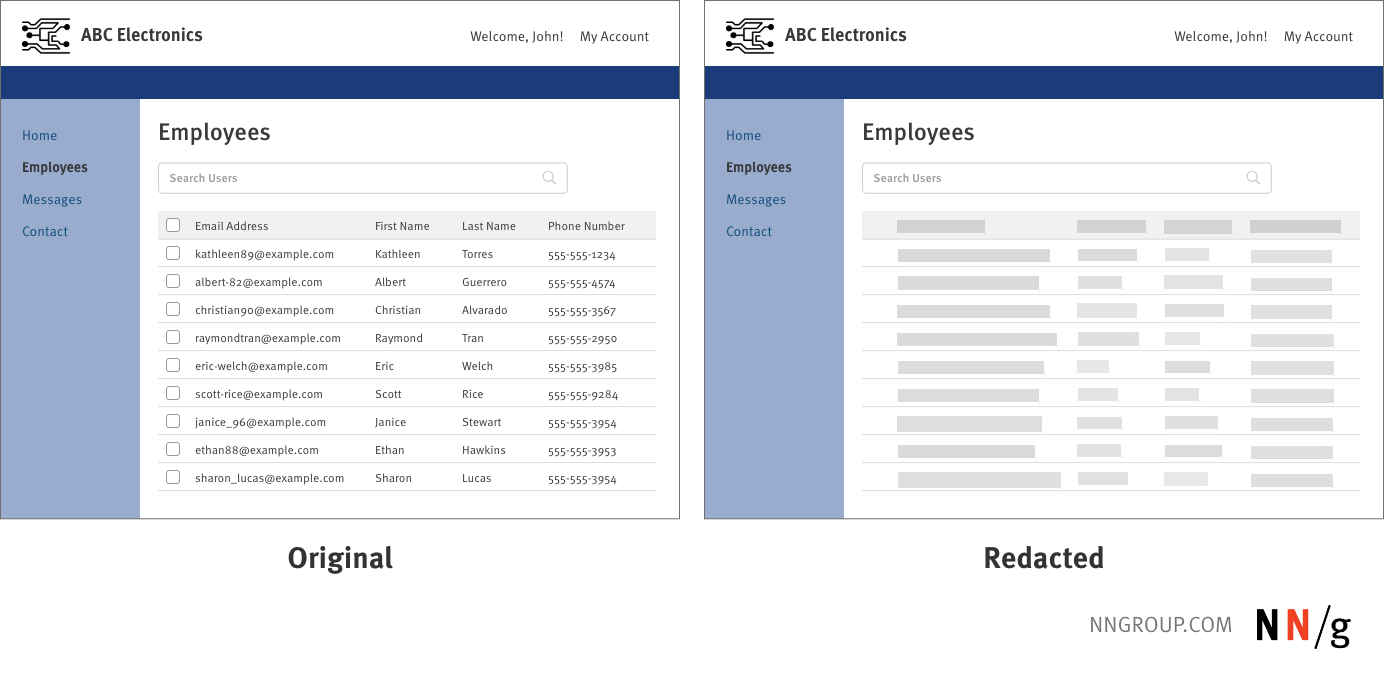
     

    Redact or blur out information. If you have wireframes or prototypes that you’d like to show, blur out identifying information. (Blurring is especially important for applications displaying financial or medical information.)

    5 Steps to Creating a UX-Design Portfolio Redacting personal information like names and contact information protects privacy of individuals while still allowing you to show your designs.
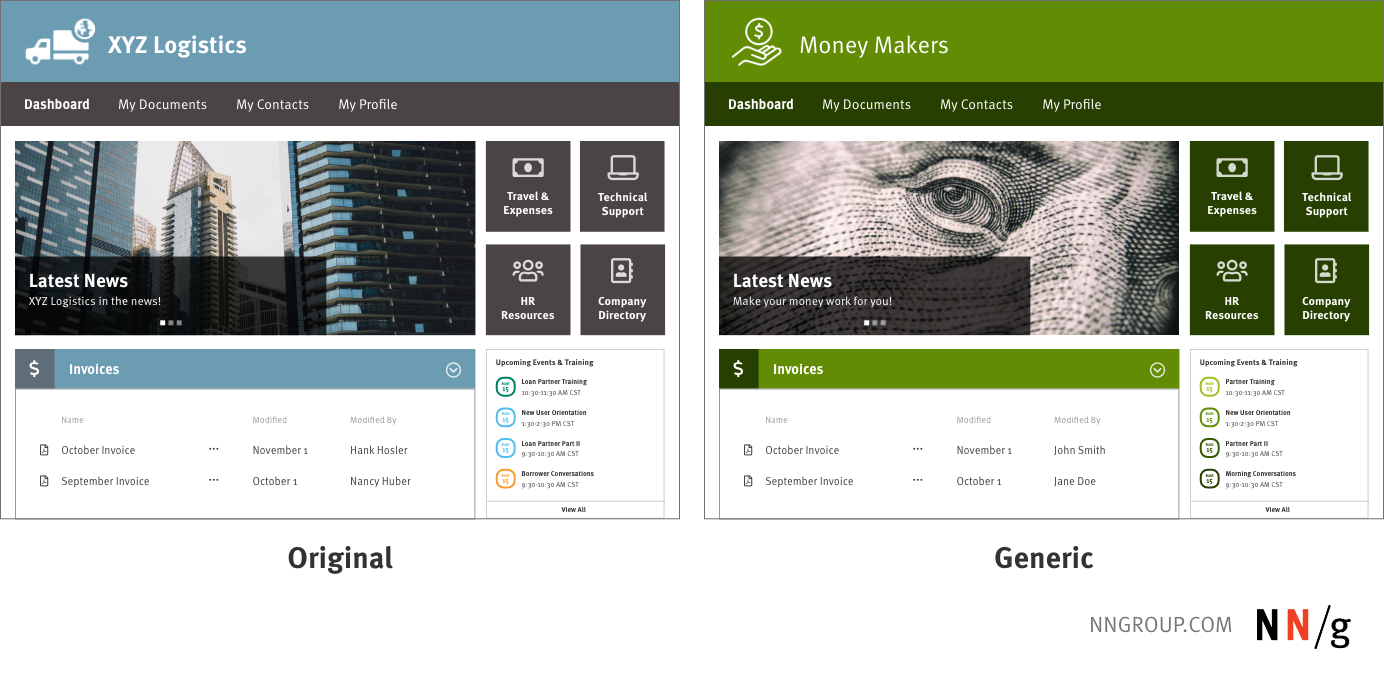
     

    Make it generic. Recreate your designs using different styles. While this approach is time-consuming, it ensures that you are not using brand colors or styles that would identify the client.

    5 Steps to Creating a UX-Design Portfolio Remove company logos, change branding, and update copy in order to show the layout and design without compromising company information. “I don’t have a lot of time. What should I focus on?”

    If you’re short on time but still want to make a big impact, focus on a project or two where you had to incorporate a wide variety of UX and design skills. These case studies will be in depth and will show off your versatility.

    “I had great ideas/designs, but they were never implemented.”

    As designers we often generate many candidate solutions for a single problem and ultimately choose only one. In this process, many great ideas are left on the cutting-room floor. As you’re writing your case studies, include candidate solutions and explain the thought process behind the designs. Hiring managers want to know that you’ll be able to navigate challenges and constraints, and you can show them that your work lives in reality instead of an ideal world.

    “I’m a student.”

    The first job is the hardest to get. It’s difficult to present a compelling design portfolio if all you can show for yourself is student projects. We strongly recommend having an internship in a company, so that you have at least one real-world project to show.

    A key aspect of any design is the ability to deal with constraints. Student projects often have made-up constraints — including made-up users and personas — which make them uncompelling proof of your ability to design for the real world. If you’re still working on your student projects, select problems that have business relevance (i.e., will make money) and realistic constraints. If you’re already done, at least acknowledge any unrealistic elements of your student projects in your portfolio description, so that managers don’t conclude that you don’t know any better.

    Conclusion

    Portfolios will always be a part of a designer’s process. Creating a portfolio that showcases your strengths in a way that appeals to your audience will help you land your next UX-design job. The act of creating a portfolio allows you to identify your skills and achievements while reflecting on the work you want to do in the future.

    When creating your UX design portfolio, remember these tips:

    • Curate, curate, curate
    • Show real work, even if it’s messy
    • Highlight collaboration with teams
    • Reflect on who you are as a designer and where you want to be

    https://samplecic.ch/5-steps-to-creating-a-ux-design-portfolio.html

    dApp Development Will Help the Healthcare Industry

    From time to time, technology will come along that can be counted on to disrupt many industries. Blockchain is one such technology. Blockchain has started to make inroads into many business sectors. Blockchain will bring only thoughts of cryptocurrencies to many people. dApp development will help the healthcare industry.

    However, technology has invaded industries as varied as healthcare and transportation. The dApp is one product that uses blockchain technology. These are applications or programs that run without centralized control. A central entity controls all applications. Blockchain technology is what facilitates the creation of dApps, so why does healthcare need blockchain technology?

    What is blockchain technology?

    It is not a technology that is used only in cryptocurrency transactions. The Blockchain is an open-source technology. In this technology, transactions get recorded on a decentralized ledger. Transactions get spread across the chain. There are no centralized agencies which control the operations. This technology cuts out the need for a middle man. Alternatively, it uses consensus from all involved parties to validate a transaction.

    It is almost impossible for someone to make a transaction without the other entities knowing about it. It allows total transparency of all transactions. Though initially, people use this technology for transactions of cryptocurrencies, many industries are looking at ways to adopt this technology. There are many advantages of using this technology, especially where there is an exchange of data between many people.

    Advantages of blockchain technology.

    Before we see how Blockchain helps the healthcare industry, we should look at the benefits of using this technology. Any technology may get used if it adds value to the existing system. Let us see how blockchain technology is beneficial. The first and most significant advantage of Blockchain is that there is no central authority to validate transactions. Every transaction gets distributed to all the members of a chain.

    Hence there is no way any tampering can happen. The fact that every transaction gets accepted by consensus will prevent any fraud. Every transaction is recorded and validated by everyone. It means that there is total transparency in the system. It improves trust in the system. Every member of the group can see the details of every transaction. In earlier systems, the data was stored in a centralized location.

    In Blockchain, it gets spread among the various servers in the system. It makes it almost impossible for anyone to enter the system and steal the data. There is no central data store for hackers to target. As there is no central agency checking or approving each transaction, the cost of transactions become much less. It results in a considerable saving of money. The system itself takes care of the job. It also saves time.

    • The Blockchain is a system that checks and approves the transactions
    • As there is no single agency supporting the transactions, there is no way tampering can take place. All purchases need the consensus of all members.
    • There is total transparency and trust because everyone can see all the transactions.
    • There is more trust as everything is out in the open for everyone to see
    • There is no centralized data storage for hackers to target.
    • Money and time savings as there is no need to wait for someone to approve the transactions.

    What ails the healthcare industry?

    Before we see how Blockchain can play an essential role in the healthcare industry, we must look at the problems that the healthcare industry faces. There are many issues concerning sharing of medical information, treatment of patients, and distribution of medicines which can use the blockchain technology. One of the primary reasons for the theft of data from EMR (electronic medical records) of patients is that they are all stored in a centralized location.

    It makes it easy for any hacker to access the data and use it for illegal purposes. Another problem with the medical record of patients is the delay in getting the data. The patient may have undergone treatment in one facility. If another health organization wants these data, they have to wait to get it. It may take longer if these facilities are located in locations far apart.

    There is always difficulty in compiling the medical details from various sources. It may be possible to integrate the medical records from wearable devices of a patient with other data. But it certainly is not easy. Today more and more people are using wearable devices to record body activities.

    • Theft of EMR is rampant as data gets stored in one location
    • Hackers need only to open one storage device to get access to all data. These hackers sell these medical data for money.
    • Sending data from one health organization to another can take a lot of time.
    • Compiling of medical records from different sources is difficult.
    • Integration of data from wearable devices with other medical records is a lengthy process.

    Using Blockchain in the healthcare industry.

    While Blockchain will help solve the above problems, it also finds a use for many purposes in the healthcare industry. Let us first see how Blockchain helps to solve the above issues. The first advantage of Blockchain is that it is fully decentralized. The system does not store any data in centralized storage devices. The data is available in a distributed manner across the whole network. There is no way hackers can target one source and get all the information.

    When the data gets distributed across the whole chain, it is easy to access the data. The patient can own the data and decide who has access to the data. It means that when the patient goes to a different healthy facility, even in a different country, he or she can show the data to the new doctor. There is no time delay or the need to wait for someone to share the data.

    Blockchain helps to merge the data from wearables to be integrated with other medical records available. Users will generate IoT data which they can consolidate with other healthcare organization data. Blockchain can help to secure IoT data with the utmost ease. Apart from the above, the main advantage is the formation of dApp, which are very helpful in the healthcare industry. Let us see how dApp can play a significant role in the industry. Before that, we need to look at what is a dApp.

    What are dApps?

    dApp stands for Decentralized Application. It is a web application meant for sharing of information between the users. Unlike other apps, there is no central ownership or managing body. All the users of the app maintain the app. Any new addition or change is made through mutual consent. A copy of the app gets stored in the computers of all the users. It doesn’t matter how many people are there in the network.

    Bitcoin is probably the first dApp which runs on the Blockchain. It is a dApp for financial transactions. There is no central financial institution controlling the transactions. Each person adds an entry to the ledger.

    Healthcare and dApps.

    Apart from helping in financial transactions, dApps have been useful in many other industries. But healthcare is an industry which can get a lot of help from this technology. Let us see how the healthcare industry can use dApps.

    dApp Development Will Help the Healthcare Industry

    Sharing of data.

    It is probably the best use for dApps in the healthcare industry. When a patient is undergoing treatment, the details get entered in the app. dApps can connect the pieces of information in a shared network. It means that the treatment detail will be available at any time if the patient is visiting another hospital for treatment.

    Another benefit is that such exchanges can help in patients getting better treatment. Sometimes patients of similar symptoms can be treated with different medication. If the data is updated, doctors can know which treatment was more beneficial and start using that medication.

    Secure data storage.

    It is another important use of dApps in the healthcare industry. The dApp can store the data and spread it across all members of the group. It means that there is no central storage server which hackers can target.

    Hospitals store a considerable amount of data on secure servers. However, these are all vulnerable to attacks by hackers who will steal the personal data of patients. Having the data spread across an app will frustrate the hackers as there will be no target for them.

    Public Health.

    If there is a dApp which gets shared between various health practitioners and organizations, they can share information about an epidemic. It will help in treating the epidemic faster. Everyone in the network can add their knowledge about different treatment methods. It is right in the case of research too. If the research details get shared in a dApp, this can help different researchers involved in similar studies. They will know the results of various trails which have been conducted by their colleagues.

    An important fact here is that all the users in the dApp verify every entry. There is no way to make a wrong entry can. Nobody can claim ownership wrongly as every entry has to be authenticated by mutual consent. The study is safe, and everyone who has contributed will get his or her credit.

    Patient Health data.

    Instead of storing the health details of patients in a centralized electronic health record, they can store in a dApp which is owned and controlled by them. They can decide who can view the app. Patients cannot access EHR now. In a dApp, the patients can integrate their medical details from wearable devices. They can also use other tools and include that data in the medical records. It will help the doctors to give a complete picture of the patients’ health.

    Agreements and contracts.

    It is a very time-consuming process getting the family members to sign the deal when someone has to undergo surgery. There are forms to be completed and signature affixed. These have to be sent to a centralized authority for approval. In the case of a dApp, the patients’ relatives and the hospital can manage this without any central authority. It is possible because the others in the group authenticate every entry. It saves a lot of time.

    A secure on-demand model.

    The on-demand service app has made its presence felt in the healthcare industry. There are apps which help in the supply of medicines. There are also apps which help you get a doctor when you want. But there was no secure app for this purpose. dApps are the solution. They can help in a very secure network of doctors and medical suppliers. If there is a problem, it is straightforward to find out where it has happened and correct it.

    As all the users of the app have to authenticate, any data entered is immediately known to all the people concerned.

    • Doctors treating patients who got treatment elsewhere can have instant access to patient’s records.
    • Doctors can arrive at the best cure for a condition as treatment methods for similar symptoms are shared.
    • Patient data is very secure as there is no central storage server for hackers to target.
    • Epidemics can be treated quickly as information about treatment is readily available on the dApp.
    • Researches researching similar diseases can share information and have access to details about various trials and results.
    • Researchers are safe when sharing information as every entry needs authentication. Nobody can make the wrong claims.
    • Patients can integrate all medical records in a dApp which they have access and can control. It is better than EHR.
    • You can integrate medical results from wearable devices and other sources in one dApp.
    • The signing of agreements and contracts are fast and secure.
    • On-demand services become safer as mistakes can be immediately located and corrected.

    Obstacles and Difficulties in Using Blockchain Technology.

    Different regions have different medical guidelines. In a blockchain network, nobody knows whether everyone is following the directions correctly. It is because there is no central authority controlling the information. Another difficulty that occurs when storing medical data is storage capacity. Each user generates a considerable amount of data. It is much more than what can get stored in a blockchain because of the size restrictions of the block.

    The time taken for data to be loaded on to the Blockchain is another matter. The process is prolonged. It is because of the number of consents that are required before it can get recorded. There is a need to find a better system than the proof-of-work method. Data cannot be changed once it gets entered in the Blockchain. It adds to the security of the data because no one can change it. But this also makes it impossible to scale the data.

    Conclusion

    The technology is still in its nascent state. There are many difficulties in using blockchain technology in the healthcare industries. There are unclear areas concerning data privacy. There is doubt about who should get access and who shouldn’t. The cost of technology is another obstacle to using it very widely. The main problem, however, would be to convince the various parties to adopt the technology and prove that it is useful and safer than present systems.

    The fact that it keeps patients’ data safe and gives them control should be enough reason to push forward this technology.

    Создайте подобный сайт на WordPress.com
    Начало работы