A 60-Second Trailer of the 60-Day Report on Cybersecurity

After delivering her report to President Obama last Friday, Melissa Hathaway, the Acting Senior Director for Cybersecurity for the National Security and Homeland Security Councils, today gave RSA Conference attendees in San Francisco a glimpse – what she called a “movie trailer” – into the state of U.S cybersecurity.

A 60-Second Trailer of the 60-Day Report on Cybersecurity

According to Hathaway’s 60 second trailer, the key to a cyber secure future lies in cooperation between the public and private sector and a united effort on both a hyperlocal front as well as globally.

A Manhattan Project to Defend Cyber Networks

Melissa Hathaway came across our radar recently when President Obama tasked the former Bush administration aide with leading a 60-day review of Bush’s Comprehensive National Cybersecurity Initiative; a largely classified, purported $30 billion, multi phase plan to address cybersecurity issues that Hathaway was involved in developing. The initiative was promptly dubbed ‘a Manhattan Project to defend cyber networks’ by the then Secretary of Homeland Security, Michael Chertoff.

The CNCI, which began as a directive from President Bush in January 2008, received much criticism and, in part, led to Obama attacking the Bush administration during his campaign for not efficiently addressing cyber threats. “As president, I’ll make cyber security the top priority that it should be in the 21st century,” Obama said during a speech in July.

Unfortunately, as pointed out by Siobhan Gorman in the Wall Street Journal, the decision to hold a 60-day review suggests that any big move in the field of national cybersecurity was once again put off. Or was it?

Who is to Blame for Internet Security Problems?

“Despite all of our efforts,” Hathaway began, “our global digital infrastructure, based largely on the Internet is not secure enough or resilient enough for what we need today and what we need for the future.”

She explained that the original design of the Internet was driven more by considerations of interoperability rather than security, and as a result we are now faced with almost insurmountable issues. Some examples include online criminals who steal our information, mass bandits who have the ability to damage portions of our internal infrastructure, and the recent ATM scam that law enforcement sources claim is one of the most frightening and well coordinated heists they’d ever seen. “In a single 30 minute period,” Hathaway said, “138 ATMs in 49 cities around the world were illicitly emptied of their cash.” This can’t continue she explained, “Our goals depend on trust and that cannot be achieved if people believe they are vulnerable to these types of threats.”

The Trailer for the Path to National CyberSecurity

We need an agreed way to move forward which involves shared responsibility, Hathaway noted, if we are to have “trustworthy, resilient, reliable” cyberspace.

Describing cyberspace and its security as “a fundamental responsibility of our government that transcends the jurisdiction of individual departments and agencies,” Hathaway explained that although each government agency has a unique contribution to make, no single agency can see the overall picture and they’ll need to work together.

Additionally, the private and the public sectors need to join forces as they are “intertwined” when it comes to cybersecurity. “While it is the role of the government to protect its citizens, it is the private sector that in the main designs and owns the majority of the digital infrastructure,” she said.

Finally, Hathaway sees this as a unique opportunity for the United States to work with countries around the world, and with organizations on an extremely local level. “We cannot succeed if our government works in isolation,” she added. It requires “leading from the top” from the White House, to government departments, to the private sector, the C-Suite, and even deeper, to the local classroom and library.

Hathaway said that her report, the culmination of a 60-day comprehensive review to assess U.S. cyberspace policies and structures, will be made public in the next few days after the administration has had a chance to review the data.

https://samplecic.ch/a-60-second-trailer-of-the-60-day-report-on-cybersecurity-116.html

A 60-Second Trailer of the 60-Day Report on Cybersecurity

After delivering her report to President Obama last Friday, Melissa Hathaway, the Acting Senior Director for Cybersecurity for the National Security and Homeland Security Councils, today gave RSA Conference attendees in San Francisco a glimpse – what she called a “movie trailer” – into the state of U.S cybersecurity.

A 60-Second Trailer of the 60-Day Report on Cybersecurity

According to Hathaway’s 60 second trailer, the key to a cyber secure future lies in cooperation between the public and private sector and a united effort on both a hyperlocal front as well as globally.

A Manhattan Project to Defend Cyber Networks

Melissa Hathaway came across our radar recently when President Obama tasked the former Bush administration aide with leading a 60-day review of Bush’s Comprehensive National Cybersecurity Initiative; a largely classified, purported $30 billion, multi phase plan to address cybersecurity issues that Hathaway was involved in developing. The initiative was promptly dubbed ‘a Manhattan Project to defend cyber networks’ by the then Secretary of Homeland Security, Michael Chertoff.

The CNCI, which began as a directive from President Bush in January 2008, received much criticism and, in part, led to Obama attacking the Bush administration during his campaign for not efficiently addressing cyber threats. “As president, I’ll make cyber security the top priority that it should be in the 21st century,” Obama said during a speech in July.

Unfortunately, as pointed out by Siobhan Gorman in the Wall Street Journal, the decision to hold a 60-day review suggests that any big move in the field of national cybersecurity was once again put off. Or was it?

Who is to Blame for Internet Security Problems?

“Despite all of our efforts,” Hathaway began, “our global digital infrastructure, based largely on the Internet is not secure enough or resilient enough for what we need today and what we need for the future.”

She explained that the original design of the Internet was driven more by considerations of interoperability rather than security, and as a result we are now faced with almost insurmountable issues. Some examples include online criminals who steal our information, mass bandits who have the ability to damage portions of our internal infrastructure, and the recent ATM scam that law enforcement sources claim is one of the most frightening and well coordinated heists they’d ever seen. “In a single 30 minute period,” Hathaway said, “138 ATMs in 49 cities around the world were illicitly emptied of their cash.” This can’t continue she explained, “Our goals depend on trust and that cannot be achieved if people believe they are vulnerable to these types of threats.”

The Trailer for the Path to National CyberSecurity

We need an agreed way to move forward which involves shared responsibility, Hathaway noted, if we are to have “trustworthy, resilient, reliable” cyberspace.

Describing cyberspace and its security as “a fundamental responsibility of our government that transcends the jurisdiction of individual departments and agencies,” Hathaway explained that although each government agency has a unique contribution to make, no single agency can see the overall picture and they’ll need to work together.

Additionally, the private and the public sectors need to join forces as they are “intertwined” when it comes to cybersecurity. “While it is the role of the government to protect its citizens, it is the private sector that in the main designs and owns the majority of the digital infrastructure,” she said.

Finally, Hathaway sees this as a unique opportunity for the United States to work with countries around the world, and with organizations on an extremely local level. “We cannot succeed if our government works in isolation,” she added. It requires “leading from the top” from the White House, to government departments, to the private sector, the C-Suite, and even deeper, to the local classroom and library.

Hathaway said that her report, the culmination of a 60-day comprehensive review to assess U.S. cyberspace policies and structures, will be made public in the next few days after the administration has had a chance to review the data.

https://samplecic.ch/a-60-second-trailer-of-the-60-day-report-on-cybersecurity-115.html

A 60-Second Trailer of the 60-Day Report on Cybersecurity

After delivering her report to President Obama last Friday, Melissa Hathaway, the Acting Senior Director for Cybersecurity for the National Security and Homeland Security Councils, today gave RSA Conference attendees in San Francisco a glimpse – what she called a “movie trailer” – into the state of U.S cybersecurity.

A 60-Second Trailer of the 60-Day Report on Cybersecurity

According to Hathaway’s 60 second trailer, the key to a cyber secure future lies in cooperation between the public and private sector and a united effort on both a hyperlocal front as well as globally.

A Manhattan Project to Defend Cyber Networks

Melissa Hathaway came across our radar recently when President Obama tasked the former Bush administration aide with leading a 60-day review of Bush’s Comprehensive National Cybersecurity Initiative; a largely classified, purported $30 billion, multi phase plan to address cybersecurity issues that Hathaway was involved in developing. The initiative was promptly dubbed ‘a Manhattan Project to defend cyber networks’ by the then Secretary of Homeland Security, Michael Chertoff.

The CNCI, which began as a directive from President Bush in January 2008, received much criticism and, in part, led to Obama attacking the Bush administration during his campaign for not efficiently addressing cyber threats. “As president, I’ll make cyber security the top priority that it should be in the 21st century,” Obama said during a speech in July.

Unfortunately, as pointed out by Siobhan Gorman in the Wall Street Journal, the decision to hold a 60-day review suggests that any big move in the field of national cybersecurity was once again put off. Or was it?

Who is to Blame for Internet Security Problems?

“Despite all of our efforts,” Hathaway began, “our global digital infrastructure, based largely on the Internet is not secure enough or resilient enough for what we need today and what we need for the future.”

She explained that the original design of the Internet was driven more by considerations of interoperability rather than security, and as a result we are now faced with almost insurmountable issues. Some examples include online criminals who steal our information, mass bandits who have the ability to damage portions of our internal infrastructure, and the recent ATM scam that law enforcement sources claim is one of the most frightening and well coordinated heists they’d ever seen. “In a single 30 minute period,” Hathaway said, “138 ATMs in 49 cities around the world were illicitly emptied of their cash.” This can’t continue she explained, “Our goals depend on trust and that cannot be achieved if people believe they are vulnerable to these types of threats.”

The Trailer for the Path to National CyberSecurity

We need an agreed way to move forward which involves shared responsibility, Hathaway noted, if we are to have “trustworthy, resilient, reliable” cyberspace.

Describing cyberspace and its security as “a fundamental responsibility of our government that transcends the jurisdiction of individual departments and agencies,” Hathaway explained that although each government agency has a unique contribution to make, no single agency can see the overall picture and they’ll need to work together.

Additionally, the private and the public sectors need to join forces as they are “intertwined” when it comes to cybersecurity. “While it is the role of the government to protect its citizens, it is the private sector that in the main designs and owns the majority of the digital infrastructure,” she said.

Finally, Hathaway sees this as a unique opportunity for the United States to work with countries around the world, and with organizations on an extremely local level. “We cannot succeed if our government works in isolation,” she added. It requires “leading from the top” from the White House, to government departments, to the private sector, the C-Suite, and even deeper, to the local classroom and library.

Hathaway said that her report, the culmination of a 60-day comprehensive review to assess U.S. cyberspace policies and structures, will be made public in the next few days after the administration has had a chance to review the data.

https://samplecic.ch/a-60-second-trailer-of-the-60-day-report-on-cybersecurity-114.html

A 60-Second Trailer of the 60-Day Report on Cybersecurity

After delivering her report to President Obama last Friday, Melissa Hathaway, the Acting Senior Director for Cybersecurity for the National Security and Homeland Security Councils, today gave RSA Conference attendees in San Francisco a glimpse – what she called a “movie trailer” – into the state of U.S cybersecurity.

A 60-Second Trailer of the 60-Day Report on Cybersecurity

According to Hathaway’s 60 second trailer, the key to a cyber secure future lies in cooperation between the public and private sector and a united effort on both a hyperlocal front as well as globally.

A Manhattan Project to Defend Cyber Networks

Melissa Hathaway came across our radar recently when President Obama tasked the former Bush administration aide with leading a 60-day review of Bush’s Comprehensive National Cybersecurity Initiative; a largely classified, purported $30 billion, multi phase plan to address cybersecurity issues that Hathaway was involved in developing. The initiative was promptly dubbed ‘a Manhattan Project to defend cyber networks’ by the then Secretary of Homeland Security, Michael Chertoff.

The CNCI, which began as a directive from President Bush in January 2008, received much criticism and, in part, led to Obama attacking the Bush administration during his campaign for not efficiently addressing cyber threats. “As president, I’ll make cyber security the top priority that it should be in the 21st century,” Obama said during a speech in July.

Unfortunately, as pointed out by Siobhan Gorman in the Wall Street Journal, the decision to hold a 60-day review suggests that any big move in the field of national cybersecurity was once again put off. Or was it?

Who is to Blame for Internet Security Problems?

“Despite all of our efforts,” Hathaway began, “our global digital infrastructure, based largely on the Internet is not secure enough or resilient enough for what we need today and what we need for the future.”

She explained that the original design of the Internet was driven more by considerations of interoperability rather than security, and as a result we are now faced with almost insurmountable issues. Some examples include online criminals who steal our information, mass bandits who have the ability to damage portions of our internal infrastructure, and the recent ATM scam that law enforcement sources claim is one of the most frightening and well coordinated heists they’d ever seen. “In a single 30 minute period,” Hathaway said, “138 ATMs in 49 cities around the world were illicitly emptied of their cash.” This can’t continue she explained, “Our goals depend on trust and that cannot be achieved if people believe they are vulnerable to these types of threats.”

The Trailer for the Path to National CyberSecurity

We need an agreed way to move forward which involves shared responsibility, Hathaway noted, if we are to have “trustworthy, resilient, reliable” cyberspace.

Describing cyberspace and its security as “a fundamental responsibility of our government that transcends the jurisdiction of individual departments and agencies,” Hathaway explained that although each government agency has a unique contribution to make, no single agency can see the overall picture and they’ll need to work together.

Additionally, the private and the public sectors need to join forces as they are “intertwined” when it comes to cybersecurity. “While it is the role of the government to protect its citizens, it is the private sector that in the main designs and owns the majority of the digital infrastructure,” she said.

Finally, Hathaway sees this as a unique opportunity for the United States to work with countries around the world, and with organizations on an extremely local level. “We cannot succeed if our government works in isolation,” she added. It requires “leading from the top” from the White House, to government departments, to the private sector, the C-Suite, and even deeper, to the local classroom and library.

Hathaway said that her report, the culmination of a 60-day comprehensive review to assess U.S. cyberspace policies and structures, will be made public in the next few days after the administration has had a chance to review the data.

https://samplecic.ch/a-60-second-trailer-of-the-60-day-report-on-cybersecurity-113.html

How to Achieve Tech-Powered Collaboration in the Era of Remote Work

Forever gone is the era when workers assembled each day at the office. Today, they’re just as likely to be working from home or spread across the globe. Collaboration has always been important among teams. But with team members no longer literally sitting side by side, collaboration tools are vital to preventing ineffective silos.

Business leaders are increasingly aware of the value of modern collaboration tools in ensuring teams stay connected. A recent survey from GoTo by LogMeIn found that 73% of businesses plan to increase spending on collaboration tools. Artificial intelligence plays a big role in these tools’ streamlining and efficiency, enabling digital assistants and automated administrative work. Put another way, AI-empowered collaboration tools are improving modern workers’ daily lives.

New Technology for a New Way of Working

Remote work doesn’t appear to be a passing trend, and it’s not just Millennials who desire flexibility. Recent surveys by Deloitte and FlexJobs found that workers of all ages appreciate autonomy in how, when, and where they complete their tasks.

The rise in remote work is occurring at precisely the same time that businesses are grappling with a talent gap. A lack of available talent is a top threat to business growth, according to a survey of CEOs by PwC. This gap is also feeding an uptick in remote workers: To attract and retain top people, companies are embracing remote or flexible arrangements.

This new way of working calls for new technology and new ways of forging connections among colleagues. Collaboration tools like Google Drive and Slack are as essential to success as the coffee machine and the copier were. These tools seamlessly connect remote workers to each other and their in-office counterparts. They increase productivity, lower costs, and even increase ROI. Collaboration tools also help companies maintain a strong culture — a keystone of success — in the absence of physical proximity.

Finally, collaboration tools can keep employees happier and free them up to focus on important work. An ICP studyfound that companies using Slack cut their email volume in half and held 25% fewer meetings. These companies experienced a 32% boost in productivity — probably because workers weren’t sifting through emails or sitting in pointless meetings.

Smart Technology Requires a Smart Strategy

Simply introducing new technology won’t immediately result in effective collaboration, which Slack’s 2018 International Work Perceptions Report defines as a melding of easy communication, mutual trust, and clearly outlined responsibilities.

Culture absolutely must inform the choice of technology and its integration into the workplace. If you haphazardly introduce new tech solutions without understanding the problems or hurdles your team faces, you could end up exacerbating issues.

Companies also make the mistake of confusing high usage of a tool with being a marker of its success. For example, many collaboration tool vendors, such as IBM and Salesforce, have copied features from social media platforms. This could mean workers are communicating more smoothly, or it could mean they’re spending a lot of time chatting. After all, sites like Facebook are designed to suck you in and never let go. The lesson here is to pay attention to how certain features are used and how they’re truly contributing to productivity and collaboration.

3 Ways to Use Tech for Enhanced Collaboration

Better collaboration equals better results. Much better results, in fact: A survey by the Institute for Corporate Productivity found that companies with collaborative environments are five times as likely to be high performers. To help your team perform stellar work, consider these tactics:

1. Make use of social tools.

Social tools can facilitate communication and streamline operations. According to “The Digitization of Collaboration” survey by Harvard Business Review, 76% of companies now employ social tools. What’s more, employees say these tools are causing notable improvements in productivity, the speed of problem-solving, and employee engagement. “Social applications allow people to work not just faster and cheaper, but also in ways they simply couldn’t have done before,” explains Heidi Gardner, distinguished fellow at Harvard Law School’s Center on the Legal Profession and author of “Smart Collaboration.”

International aid organization Oxfam, for example, used a social platform to destroy email silos and improve collaboration and communication. Without the social tool, communication among Oxfam’s coalition of 20 independent charities was arduous.

2. Mix up reality.

Virtual and augmented reality are reshaping team collaboration, facilitating remote team project discussions, and providing virtual workrooms. “While the latest AR/VR and 3D technologies have been applied to the worlds of gaming and entertainment for years, the opportunity for more immersive experiences within enterprise learning, training, and workflow management is now, for the first time, on the verge of global adoption,” says James Henry, chief technology officer at PureWeb, an interactive 3D streaming service.

One such tool is Microsoft’s HoloLens, a mixed-reality headset by Xbox that represents the entertainment brand’s foray into business applications. HoloLens users can see 360-degree views of virtual spaces, create 3D items, and see holograms during video calls.

3. Unburden workflows with AI.

AI is key to honing and automating workflows. It can streamline workflows by handling repetitive tasks, eliminating human error, analyzing risks, and tracking schedules and budgets. Chatbots, for instance, can schedule and transcribe meetings, proofread content, and automate communication when project steps are completed. Chatbot technology has already been integrated with platforms such as Slack, Cisco Spark, Microsoft Teams, and others.

AI can also help filter and organize information, protecting workers from the constant and overwhelming stream of interruptions and data that modern collaboration tools sometimes produce. Slack, for example, uses collaborative filtering to free up workers to do what they do best: lead teams and dream up creative ideas.

Technology has rescued us from the days of “butts in seats,” and it’s providing the means to ensure that remote work really works. New collaboration tools incorporating AI, VR, and other cutting-edge tech are improving the way we collaborate and communicate, making virtual teams an asset instead of a liability.

https://samplecic.ch/how-to-achieve-tech-powered-collaboration-in-the-era-of-remote-work.html

A 60-Second Trailer of the 60-Day Report on Cybersecurity

After delivering her report to President Obama last Friday, Melissa Hathaway, the Acting Senior Director for Cybersecurity for the National Security and Homeland Security Councils, today gave RSA Conference attendees in San Francisco a glimpse – what she called a “movie trailer” – into the state of U.S cybersecurity.

A 60-Second Trailer of the 60-Day Report on Cybersecurity

According to Hathaway’s 60 second trailer, the key to a cyber secure future lies in cooperation between the public and private sector and a united effort on both a hyperlocal front as well as globally.

A Manhattan Project to Defend Cyber Networks

Melissa Hathaway came across our radar recently when President Obama tasked the former Bush administration aide with leading a 60-day review of Bush’s Comprehensive National Cybersecurity Initiative; a largely classified, purported $30 billion, multi phase plan to address cybersecurity issues that Hathaway was involved in developing. The initiative was promptly dubbed ‘a Manhattan Project to defend cyber networks’ by the then Secretary of Homeland Security, Michael Chertoff.

The CNCI, which began as a directive from President Bush in January 2008, received much criticism and, in part, led to Obama attacking the Bush administration during his campaign for not efficiently addressing cyber threats. “As president, I’ll make cyber security the top priority that it should be in the 21st century,” Obama said during a speech in July.

Unfortunately, as pointed out by Siobhan Gorman in the Wall Street Journal, the decision to hold a 60-day review suggests that any big move in the field of national cybersecurity was once again put off. Or was it?

Who is to Blame for Internet Security Problems?

“Despite all of our efforts,” Hathaway began, “our global digital infrastructure, based largely on the Internet is not secure enough or resilient enough for what we need today and what we need for the future.”

She explained that the original design of the Internet was driven more by considerations of interoperability rather than security, and as a result we are now faced with almost insurmountable issues. Some examples include online criminals who steal our information, mass bandits who have the ability to damage portions of our internal infrastructure, and the recent ATM scam that law enforcement sources claim is one of the most frightening and well coordinated heists they’d ever seen. “In a single 30 minute period,” Hathaway said, “138 ATMs in 49 cities around the world were illicitly emptied of their cash.” This can’t continue she explained, “Our goals depend on trust and that cannot be achieved if people believe they are vulnerable to these types of threats.”

The Trailer for the Path to National CyberSecurity

We need an agreed way to move forward which involves shared responsibility, Hathaway noted, if we are to have “trustworthy, resilient, reliable” cyberspace.

Describing cyberspace and its security as “a fundamental responsibility of our government that transcends the jurisdiction of individual departments and agencies,” Hathaway explained that although each government agency has a unique contribution to make, no single agency can see the overall picture and they’ll need to work together.

Additionally, the private and the public sectors need to join forces as they are “intertwined” when it comes to cybersecurity. “While it is the role of the government to protect its citizens, it is the private sector that in the main designs and owns the majority of the digital infrastructure,” she said.

Finally, Hathaway sees this as a unique opportunity for the United States to work with countries around the world, and with organizations on an extremely local level. “We cannot succeed if our government works in isolation,” she added. It requires “leading from the top” from the White House, to government departments, to the private sector, the C-Suite, and even deeper, to the local classroom and library.

Hathaway said that her report, the culmination of a 60-day comprehensive review to assess U.S. cyberspace policies and structures, will be made public in the next few days after the administration has had a chance to review the data.

https://samplecic.ch/a-60-second-trailer-of-the-60-day-report-on-cybersecurity-112.html

Venture Capital Is Just One Funding Option, Reminds OnPay’s Mark McKee

Virtually every startup has to find funding somewhere. Although some founders take venture capital in exchange for equity, that’s not the only way to do it.

To learn more about the pros and cons of venture capital — and founders’ funding alternatives — I caught up with Mark McKee. Before being named president and COO of OnPay, a growing online payroll solution for small businesses, McKee worked as managing director of The Lenox Group, where he advised growing companies on how best to raise and structure capital.

Here’s his take:

Brad Anderson: As someone who’s worked in investment banking and been an early employee at a startup, do you think most founders understand their financing options? Why or why not?

Mark McKee: Most first-time founders I’ve met don’t, frankly. Serial entrepreneurs usually have a sense of the funding landscape, but new ones typically assume venture capital must be the right route.

In my mind, that’s for two reasons: The economy is good, so venture investors are flush with capital. That creates a market where equity funding is top of mind.

The other piece of the puzzle is that equity deals tend to get a lot of press coverage. That makes new founders think, “Oh, this must be the way to go.” Oftentimes, it is. But there are real trade-offs that many first-time founders aren’t aware of.

Anderson: So is venture capital the right approach for most startups? What are the pros and cons?

McKee: I think equity funding can be the right answer. Any type of funding can be an accelerant, but that doesn’t necessarily make the work of an entrepreneur any easier. The journey is hard, whether you take venture money or not. 

With that said, there are some real advantages to it. VCs have been through it before. They can provide guidance, experience, and introductions that many new entrepreneurs struggle to get otherwise. 

The trick is to make sure they’re aligned with your plan: How big do you want the company to become before you make your exit? How do you collectively plan to finance the business as it grows?  Are they happy with the marketing and branding? Do they want you to expand to other markets and geographies?

That’s one of the real cons of venture capital. You typically have to give up control. When you give up some ownership to investors, you need to be ready to accept their input.

Do a gut check. Before taking any money, make sure your investors are smart people who can support the growth of the business. If you’re aligned on the front end, you drastically decrease the chances of conflict later.

Once you bring in equity, you need to be comfortable with that path. If you’re doing well, VCs will want to put more money into your company. If you’re doing really well, it becomes hard to take existing investors out at a reasonable valuation. But if you’re not doing well, of course, it becomes tough to bring other investors in. 

Anderson: What if founders aren’t willing to accept those cons? What alternatives should they consider?

McKee: If you’ve grown your business to the point of positive cash flow, you should explore debt options. OnPay took private debt, but alternative lenders like Kabbage are great options as well. SBA loans are another low-interest route to consider.

If you do know a wealthy individual who would guarantee a loan for you in exchange for options in your business, go for it. That way, that person doesn’t have to outlay the actual cash. Your bank will be happy, too.

One area I think is often overlooked is grants and competitions. It’s non-dilutive capital you don’t have to pay back, plus it tends to create a great PR opportunity. You could try an online platform like Kickstarter, but you’re probably better off entering a venture competition. 

Basically, a bunch of tech startups pitch or demonstrate their product to a committee. The winner usually gets somewhere between $10,000 and $100,000. It’s a supplemental source of funding — and winners often get the attention of local VCs. 

Anderson: Can you describe how OnPay has viewed fundraising and how your path has worked for you?

McKee: We’re a payroll software company, but we spun out of a traditional payroll firm. That initial structure didn’t allow for us to bring in an equity growth investment. We bootstrapped the company, operating in a break-even cash flow environment.

That was tough, and we were eventually able to take on some debt. We reached out to high-net-worth individuals and small funds. We used those assets to growth further; now, we have equity investors and a bank loan.

It wasn’t necessarily easy, but that path worked for us. Our approach is to be capital-efficient; we only take in what we need. We view ourselves as stewards of our investors’ money.  

Anderson: What if OnPay hadn’t self-funded at the start? What can other entrepreneurs learn from OnPay’s approach?

McKee: If you can get equity funding early, do it. Had OnPay’s initial capital structure allowed for it, we would’ve done it. You need all the money you can get when you’re first exploring what an idea can be.

Be patient if venture investors aren’t biting. We couldn’t take equity money, so we found other ways to finance the business until we found product-market fit and started scaling. We took money from smart people with the experience to help us, and it actually put us in a much better place today.

Just as importantly, bet on yourself and your team. We’re proud of OnPay’s people because they allowed us to stretch. Before we raised equity, we knew we were asking a lot from our team. That was frustrating for us at times, but we pulled through.

https://samplecic.ch/venture-capital-is-just-one-funding-option-reminds-onpays-mark-mckee.html

Regulatory Tips for Medical Tech Startups Regulated by the FDA

Medical tech startups are regulated by the FDA and must abide by strict regulations at all times. For example, all medical devices must be approved by the FDA. Acting outside of the FDA’s regulations can result in harsh penalties including fines and even jail time.

Whether your medical tech startup produces low-risk or high-risk devices, compliance is a crucial and complex necessity.

1. Stay on top of regulatory changes

If you don’t stay on top of regulatory changes you could be in trouble. For example, the recently adopted GDPR regulations threw a wrench in every business owner’s compliance protocols. Businesses owners had a short period of time to comply before penalties would be legally assessed for violations.

The same can happen in the medical tech world. One day, you might be comfortable with the current regulations and the next day there’s a new regulation you need to comply with. Or, a current regulation might be amended.

The best way to stay ahead is to stay on top of proposed changes in regulatory compliance. Nothing becomes law overnight without a process beforehand.

2. Warn patients not to mix-and-match components

It’s important to warn against swapping out unauthorized device components for any reason. Patients may not understand why they shouldn’t use other components with their device. It’s critical to warn that using unauthorized components can result in injury and/or death, depending on your device. These warnings should be placed in the box for patients and in the literature given to health care providers.

Patients need to understand that the FDA authorizes medical devices for a specific use even when there are multiple components involved. For example, an automatic insulin dosing system comes with several authorized components including an insulin pump, a glucose monitoring system, and an algorithm that determines the dose of insulin. These three devices are tested and authorized together as a complete system.

Sometimes patients decide to mix-and-match components from other systems (or they buy a cheaper, unauthorized component to replace one that broke) and it doesn’t work correctly and ends up harming the patient. For example, the FDA received a report of a serious adverse event related to a blood glucose monitoring system. The system was used with an unauthorized component and resulted in an insulin overdose.

3. Keep a tight watch on your electronic record practices

According to Title 21 (Part 11) of the Code of Federal Regulations, all computer systems used to create, modify, and maintain electronic records and signatures (including mobile devices) are subject to FDA validation. All hardware and software must be readily available at all times for FDA inspection. Arbour Group explains 13 key elements of these regulations including:

  • Validation of systems to ensure accuracy, reliability, consistent intended performance and the ability to discern invalid or altered records.
  • Ability to generate accurate and complete copies of records in both human readable and electronic form suitable for inspection, review and copying.
  • Protection of records to enable accurate and ready retrieval throughout the record retention period.
  • Limiting access to authorized individuals.
  • The use of secure, computer-generated, time-stamped audit trails to independently record the date and time of operator entries.
  • Record changes shall not obscure previously recorded information and audit trails are to be maintained as long as the associated electronic record.
  • And more

Handling electronic records according to regulations can’t be done on a whim. Compliance requires a strict system that uses software to restrict access and secure records, among other tasks. Compliance with electronic records regulations are complex. The stakes are too high; there’s no room for mistakes.

4. Be absolutely certain if you don’t think your product qualifies as a device

When you think of medical devices, you probably think of pacemakers, syringes, and nebulizers. However, even a simple tongue depressor is considered a medical device and subject to FDA regulations.

Whether or not something is considered a medical device is determined by The Federal Food Drug & Cosmetic Act. In summary, a product is considered a medical device when:

  • The device is used in the process of diagnosing, treating, or preventing a disease or condition. Tongue depressors meet this qualification.
  • The device is intended to affect the structure or function of the body without chemical action. This qualification separates drugs from medical devices.

If you’re not sure if your product is a medical device, head over to the FDA’s CDRH Classification Database to review products the FDA considers devices. If you find something that matches your product, it’s probably considered a medical device and is regulated by the FDA.

5. Don’t go to market without a pre-market application

There are two ways you can bring your product to market, but just launching on your own isn’t one of them. If your medical device is considered a Class III device, you’ll need to go through the Pre-Market Approval (PMA) process. If your device is a Class I or II device, you’ll go through the 510(k) process.

With the 501(k) process, you must demonstrate the device is “substantially equivalent” to a previous device. If this is the path you must take, you’ll need bench testing data and a small clinical study. The process may only take a few months.

The PMA process is more involved. You’ll need to perform larger, multi-center, randomized clinical trials to obtain your data. You can expect to involve hundreds or thousands of patients in your trials and it will likely cost in the tens of millions of dollars.

The FDA is strict with PMAs and in 2012, only approved 37.

6. Know that apps aren’t automatically exempt from regulations

Health apps are abundant, claiming to measure your pulse, heartrate, and some apps even claim to help you lose weight. It’s unclear whether these apps are accurate or just for fun, but the FDA doesn’t care – when an app claims to do something that is also accomplished by a medical device, the app might require regulation.

The FDA announced they don’t plan to review all medical apps but will stay focused on apps designed for use with FDA-approved medical devices. However, that doesn’t mean you’re off the hook.

Apps are hot, but before launching a health-related app, find out if it requires regulation. It might sound silly now, but if a consumer misuses your app in the future and suffers harm, they might end up suing you.

7. Stay caught up with medical device lawsuits

Stay caught up with medical device lawsuits as a reminder that details do matter, and violations are enforced.

When you send out your weekly or monthly newsletter to your team, include a section for recent news. Use that section to make your team aware of any current lawsuits, fines, and other penalties paid by companies who chose to ignore compliance regulations. Keep the reality in their awareness so they’re not tempted to take shortcuts or forge data behind your back.

Medical device lawsuits are abundant. For example, in December 2018, Minnesota-based medical device manufacturer ev3 agreed to plead guilty and pay $17.9 million for disregarding safety laws. The company distributed a neurovascular medical device called Onyx. Onyx, a liquid embolization device, was originally approved by the FDA for use inside the brain.

According to the FDA, between 2005-2009, sales reps from ev3 encouraged surgeons to use Onyx outside the brain in unproven and dangerous ways. The company was told they need to perform a study to get those uses approved, but the company ignored the warnings. The company incentivized sales reps to promote unauthorized uses and the sales reps even attended surgical procedures where they instructed surgeons on what to do.

8. Prepare to conform to regulation changes

It’s possible that your device’s technology might be ahead of current regulations. If you’re an innovator, expect to be required to comply with regulations you may not have needed to comply with when you first launched.

Be aware that regulatory changes in the European Union and Canada can affect your company in the United States. For example, the Medical Device Single Audit Program (MDSAP) was adopted in the U.S., Brazil, Canada, Japan, and Australia. This program is designed to enhance product quality and safety and help determine the lifecycle of a product.

The MDSAP program also changes the way inspections are performed, so be ready and willing to do things differently when required.

Don’t move forward before you’re ready

Avoid troubling situations by following regulation requirements from the start. Don’t procrastinate or skip any duties you have to the public. Don’t announce your device’s efficacy before the data comes in. Know for sure before you start marketing your device. It’s tempting to start marketing before your trials have been completed, but if the data doesn’t live up to your expectations you’ll be in a bad situation. You’ll either need to lie to move forward, or admit a mistake to make things right.

If you need more time to conduct trials and studies, take that time. People feel better about using medical devices when there’s strong evidence they’re safe and effective.

https://samplecic.ch/regulatory-tips-for-medical-tech-startups-regulated-by-the-fda.html

Learning From Silicon Valley About Blockchain Adoption

One of Silicon Valley’s most compelling attributes is its lack of interest in the traditional bottom line. While most companies focus on revenue and profitability, Silicon Valley leaders tend to view valuation as a success barometer. Because of this mindset, Valley-based companies don’t mind taking significant risks as long as they help achieve big-picture visions. But we can learn from Silicon Valley about blockchain Adoption.

What is the Risk of Blockchain?

One new risk that has begun to pay off is blockchain, and non-Valley companies are taking notice. The International Data Corporation predicts that blockchain spending will reach $11.7 billion by 2022 and extend its reach beyond the tech and banking industries.

Who Embraces Blockchain?

Despite blockchain’s obvious applicability to several industries, it’s a solution that some leaders still haven’t embraced. Some of that hesitation stems from a confused association with cryptocurrency, which has good and bad connotations. Some, however, is because of blockchain’s perceived small impact on the bottom line. In 2019, however, blockchain’s potential value is becoming more apparent.

Most leaders who are aware of it are seriously considering its use cases, while more skeptical executives now find themselves much more open to investing in the technology. Silicon Valley drafted the blueprint for embracing blockchain — it’s time for companies beyond the Bay Area to take a risk and follow suit.

Clearing Up Blockchain Confusion

Similar to any emerging tech, blockchain comes with a slew of new terms and terminology that don’t necessarily mean a lot. People interested in creating unique marketing opportunities for themselves can take advantage of the buzzy nature of terms like blockchain, artificial intelligence, and big data. These buzzwords enable them to peddle products or services that don’t really do anything new — or don’t actually exist.

Misinformation is floating around, and C-suite executives are understandably dubious of new technology.

Because so much misinformation is floating around, C-suite executives are understandably dubious of new technology and hesitant to embrace more modern solutions to old problems.

To get a better sense of blockchain’s value, leaders must understand the truth regarding several common misconceptions: • It’s the same as bitcoin.

While blockchain is essential to how cryptocurrency works, it’s worth doesn’t begin and end with bitcoin. At its core, blockchain is a decentralized and secure way to keep digital records. A blockchain consists of different “blocks” of data that are connected to others using cryptography, creating a string (or chain) of information stored on a variety of computers.

What puts blockchain over traditional methods of business logging is its transparent and immutable nature. It can’t be tampered with or changed, and every block can be accessed and viewed. Protection of the block creates a clear and complete line of accountability, which is useful for more than just creating money.

• It replaces relational databases.

Because services like SQL Server and Oracle cover similar territory as blockchain, some people assume it’s meant to replace more traditional relational databases. However, blockchain platforms are still mostly nascent and aren’t intended to replace more entrenched solutions. Blockchain exists as more of a complementary option.

• It gets rid of the middleman.

While it’s true that blockchain has enabled Bitcoin to eliminate intermediaries from its transactions, that’s not the case in other applications. As long as transactions remain in an internal ecosystem, they don’t require outside validation. When it comes to interacting with the world at large, however, intermediaries can still help with data input and identity verification.

• It’s just a public peer-to-peer system.

The big selling point of many blockchain implementations is the public nature of each transaction. This transparency has led many businesses to believe that blockchain can only exist in a public setting — or that creating a permission-reliant application isn’t possible. While that’s currently the most common version, blockchains do not have to be open to every participant. They can be limited to only those who need to know certain information.

Like any new technology, the success or failure of blockchain’s adoption rests in its applications.

Executives need to look past the marketing jargon and flashy promises that make blockchain look like a messy tech fad.

They must instead figure out their own core goals — and then decide whether blockchain can help them reach those goals faster.

Blockchain’s Place in Today’s Business Environment

For businesses, one benefit of Silicon Valley’s risk-taking nature is that it allows others to learn from its successes and failures. Here are a few ways that blockchain already has proven its worth:

1. Coordinating Document Control and Third-Party Sharing

Despite its reputation as a publicly distributed solution, blockchain is a perfect way to securely share information without risking it getting into the wrong hands. In industries such as healthcare, where security is paramount, this could be a game-changer. It gives the right people easy access to comprehensive data with significantly reduced security risks.

2. Partnering With AI to Improve Oversight and Insights

In traditional workspaces, databases often turn into data silos — centralized sources that are hard to share across departments or between companies. Blockchain, however, should be shared with those who need it as a perfect universal repository for businesses or entire industries.

This sharing is critical not only to better communication but also to better data insights. As more information is gathered and shared, machine learning gleans patterns from these findings. Furthermore, what might not be apparent to one expert could be evident to someone who has different skills or knowledge — enabling outside-the-box thinking that is not possible with data silos in place.

3. Improving Sourcing With Customer Data

Because blockchain is so easy to distribute securely, collaborators can readily collect, read, and analyze information from all over the globe. When it comes to identifying which vendor produces the highest-quality product, data from customers can give accurate insight into which direction to take.

4. Predicting Equipment Maintenance Patterns

Platforms such as TMW Systems offer solutions that use blockchain to alert companies when something goes wrong. They also collect data about each occurrence. Allowing companies to understand when and why pieces of equipment fail can save capital and time in the long term.

Blockchain is no longer a technology best left to the inhabitants of Silicon Valley.

There are specific use cases that any business can put into place, and blockchain is no longer a technology best left to Silicon Valley. For executives, it’s no longer enough to wonder whether you should consider blockchain — you should already be figuring out how to best put it to use.


Image Credit: jorge-fernandez-salas-f5OO7rL6OD8-unsplash

https://samplecic.ch/learning-from-silicon-valley-about-blockchain-adoption.html

Cancel vs Close: Design to Distinguish the Difference

Long ago, the symbol X meant “this is where the treasure is buried.” In today’s digital interfaces, X no longer marks the spot, but rather functions as a way for users to cancel a process or to dismiss an interim screen. How can one tell for sure whether the X means cancel or close? Sometimes, unfortunately, you can’t.

The main issue lies with the common lack of a text label for the X icon. When an icon represents multiple meanings in similar contexts across different interfaces, icon usability suffers because users cannot rely on any single interpretation.

Avoid Losing Users’ Work

When users intend to dismiss a modal or view by clicking the X button, but the system instead completely cancels the process and clears all their work, it is disheartening at best, and maddening at worst. Yes, the X icon is commonly recognized by users to mean either to cancel or to close, but distinguishing between the two possibilities is critical for the success of the interaction.

In some cases, the distinction between cancel and close doesn’t matter. When a popup takes over the majority of your screen, hitting the X button (as quickly as humanly possible) serves to both close that modal and perhaps cancel any process it might have triggered. However, if a screen contains a running timer, is playing audio, holds several selected filter options, or contains some other type of unsaved work, it becomes much more important to correctly interpret what that X icon represents — you may intend to leave that timer or audio running, apply those selected filters, or save your in-progress work, while wanting to close that view to continue some other related activity.

For example, the Sephora checkout process used a modal window to present free samples that users could add to their cart. In the following example, an item had just been selected by clicking the Add button below it; that action caused the Add button to be replaced by a Remove link, which made it look as if the sample had already been added to the cart. However, when the user closed the modal by clicking the X icon rather than Done link, she discovered that the item was not in the cart and that she needed to add it again.

Cancel vs Close: Design to Distinguish the Difference Sephora: Even though it looked as if the sample had already been added to the cart because it could now be removed, closing the modal (by clicking the X in the top right corner) canceled the process of choosing a trial item. To add the item to their carts, users had to first click Add and then apply that action by clicking the Done link.

To avoid losing users’ work, systems need to determine the user’s intent — cancel or close — and provide clear options.

This goal can be accomplished by one or more of the following:

  • Asking the user to confirm their intention
  • Using explicit text labels rather than ambiguous icons
  • Presenting two distinct buttons: X for closing the view (with the side effect of saving intermediate work) and Cancel for abandoning the process

1. Ask for Confirmation

If a user pressed the X icon on a modal or intermediate view where she had already performed an action, the UI could confirm her intention by directly asking whether to apply that action before closing the view. This solution is ideal for destructive cancel actions that would lose the user’s work. Here, the old adage that it’s better to beg forgiveness than ask for permission is absolutely not true — always ask for confirmation before committing destructive actions.

For example, filter views are often accidentally closed, and that action causes users to lose their work. This problem is particularly rampant on mobile interfaces, as filter screens often consume the majority — if not all — of the available screen space, making it difficult or impossible to tell whether selections have already been applied.

To guard against potential mistakes, ask users who close a filter view whether they intend to apply the filters and close the view or clear their selections. For instance, the Lowes mobile app showed a confirmation dialog when the user attempted to close the filter screen before applying her selections.

Cancel vs Close: Design to Distinguish the Difference Lowes mobile app: Tapping either the X button or the Back arrow could reset any selections and take the user back to the previous result set. Right: After tapping X, a confirmation dialog appeared to check whether the user meant to apply or cancel the filter refinements before returning to the results list.

Similarly, the language-learning app Duolingo showed a confirmation dialog when users attempted to close an in-progress lesson — lessons could not be left partially completed and had to be either finished or cancelled. At least, the app communicated this constraint to users and gave them the option to return to the lesson to maintain progress.

Cancel vs Close: Design to Distinguish the Difference Duolingo: Clicking the X button would end the current lesson and forfeit any progress. To guard against mistakes, the app included a confirmation dialog.

While confirmation dialogs are effective in disambiguating the meaning of the X icon, they add extra steps; moreover, users don’t know what the X does before they press it and, therefore, they may worry about the consequence of their action.

2. Use Explicit Labels

Rather than relying on confirmation dialogs to catch users before they unwittingly lose all their selections, you can eliminate the ambiguous X icon in favor of explicit text-labeled buttons. Text can reduce ambiguity and clearly communicate what action would occur: cancel versus close.

The filter screen of Yelp’s mobile app offered buttons labeled Cancel and Reset at the top of the screen and a single large Apply button at the bottom. Similarly, the filter view in the Etsy mobile app provided separate buttons labeled Clear and Done. (Note: Etsy used Done rather than Apply because the filters were applied as soon as they had been selected, as is recommended for toggle switches.)

Cancel vs Close: Design to Distinguish the Difference (Left) Yelp mobile app: Text labels for Cancel, Reset, and Apply were direct and clear, making it less likely that users would inadvertently close the view and lose their filter selections. (Right) Etsy mobile app: The text label Clear gave a clear way (pardon the pun) for users to cancel their selections. The Done link returned to the product-listings page, with the selections already applied. 3. Favor Close & Save
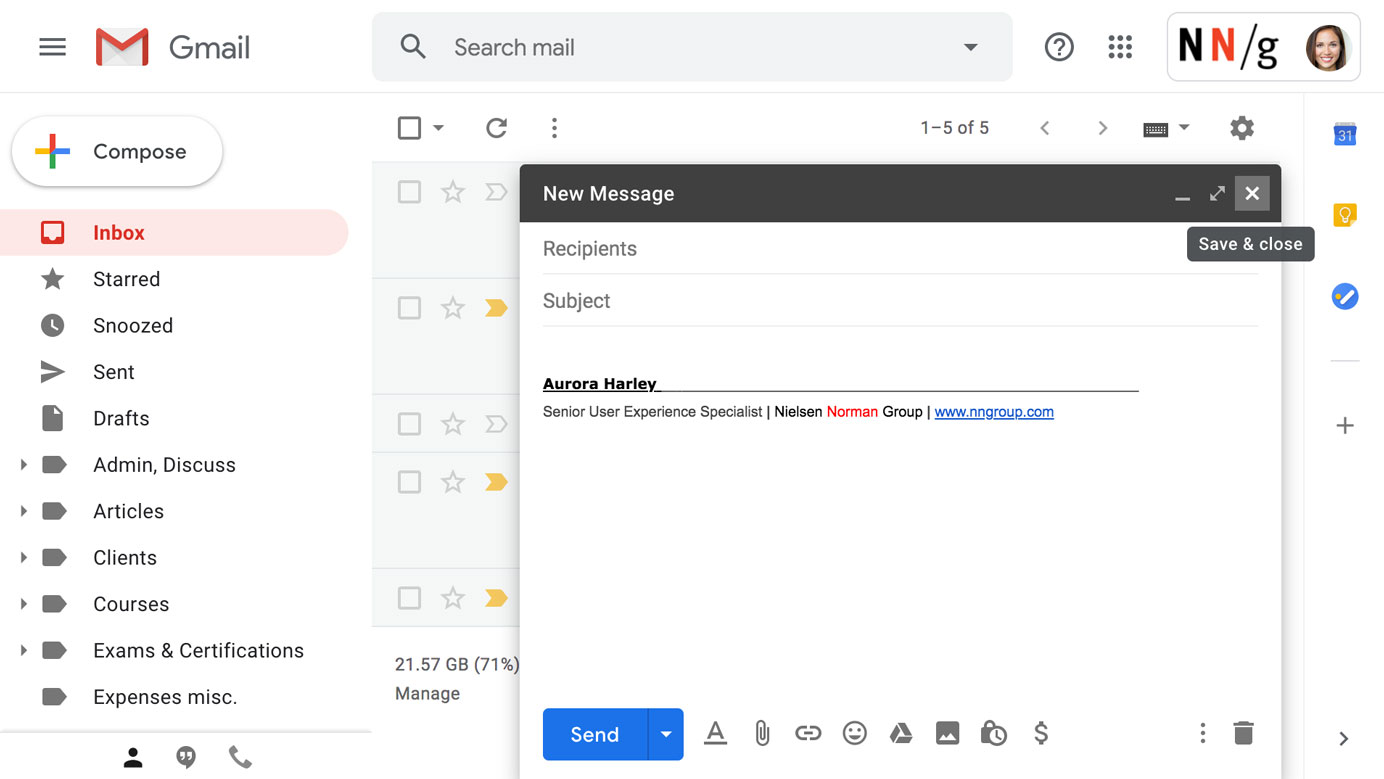
If the X icon must be used rather than text (to save space or because you’re following your organization’s style guide), err on the side of caution and save any intermediate work that has been done. In addition, provide a separate Cancel button, to give users an emergency exit out of the process and to disambiguate between the two possible meanings of the X (closing and cancelling).

For example, Gmail automatically saved a draft of a message composed in its nonmodal window. This practice allowed users to collapse or close the window when desired, while still saving their progress. Hovering over the X icon in the top right corner of the message window displayed a tooltip confirming that the draft was going to be saved and closed. Cancelling was also still available (using the Delete trash can icon at the bottom of the message window — far from the Save & close option at the top to help prevent mistakes).

Cancel vs Close: Design to Distinguish the Difference Gmail: Hover revealed that the X icon was for dismissing the window and not for deleting the draft, allowing users to Save & close the message window without losing work in progress.
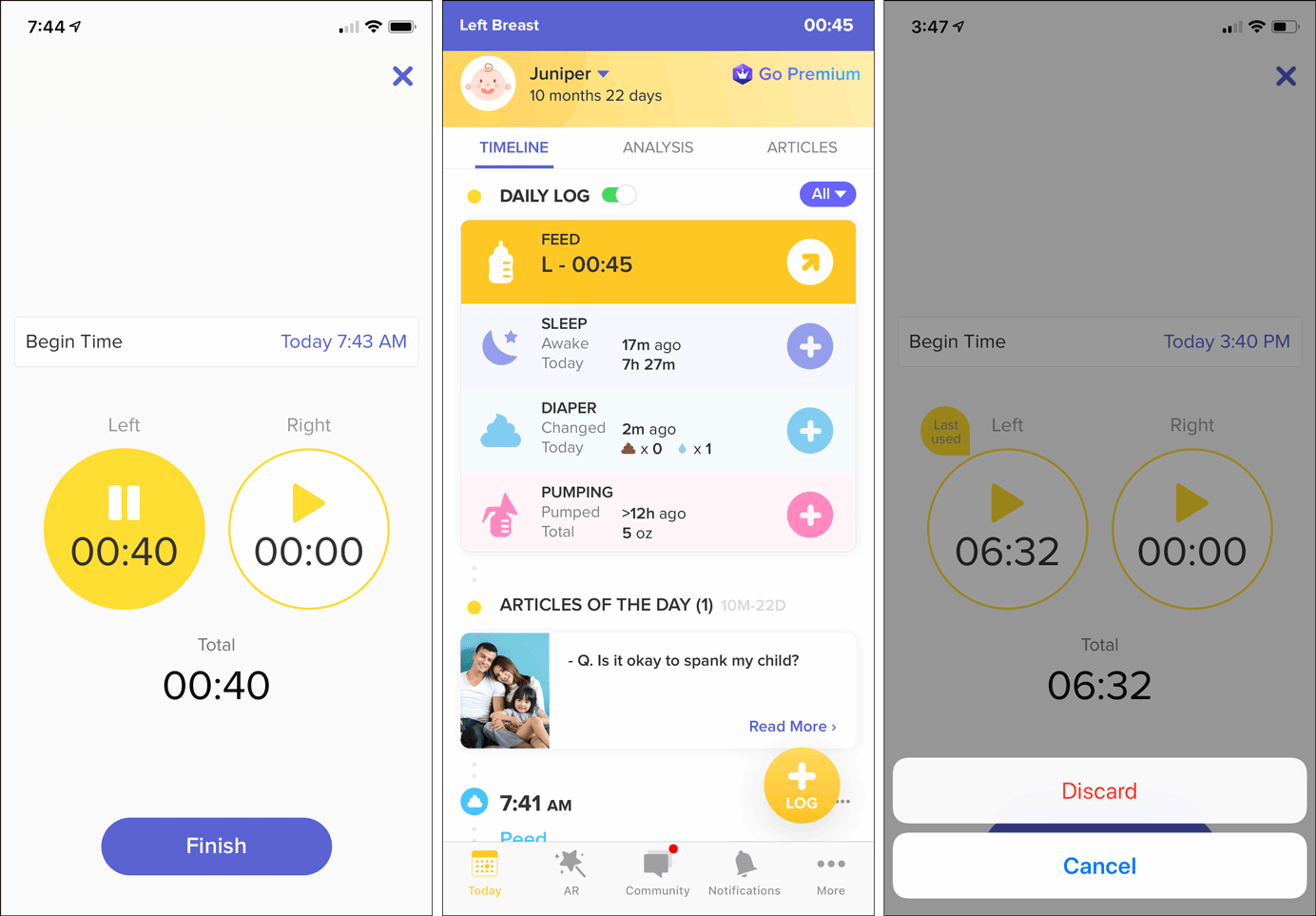
Saving by default can also be a good solution for long processes or processes that tend to be run in the background, such as timers. For instance, the Glow Baby mobile app allowed users to browse other areas of the app while a feeding or sleeping timer ran in the background. Because these timers can run for a long period of time (hopefully, a very long time for the sleeping timer!), this functionality let the user accomplish other tasks in the app, like recording a past diaper change or browsing through articles and forums. Tapping the X icon in the timer view simply dismissed the window without canceling the running timer.

Cancel vs Close: Design to Distinguish the Difference Glow Baby: (Left) Tapping the X icon in a running-timer view dismissed the view without canceling the timer, and thus, allowed the user to continue using the app to log other types of events, participate in the community discussions, read articles, and so on. (Middle) The status for the running timer was displayed in a banner at the top of the screen. (Right) Hitting the X while the timer was paused brought up the Discard or Cancel buttons to detect the user’s intention.

Note that saving intermediate work or maintaining an ongoing process before closing is proactive, but sometimes can be contrary to the user’s intention: If users intend to cancel their selections by clicking the X button, auto applying those selections could be confusing and frustrating. This is why it’s critical to also include a separate Cancel button, to give users an out rather than forcing them to only save and close the view.

Conclusion

While the X icon is ambiguous and can often cause usability problems, it’s unlikely that it will disappear from all interfaces any time soon. Designers should be aware of the multiple meanings of the X icon and disambiguate between close and cancel, as well as provide safeguards such as confirmation dialogs or autosaving to avoid losing any users’ work.

Remember, when in doubt, save, then out.

https://samplecic.ch/cancel-vs-close-design-to-distinguish-the-difference-2.html

Создайте подобный сайт на WordPress.com
Начало работы