What B2B Designers Can Learn from B2C About Building Trust

A widespread misconception with business–to–business (B2B) sites is that they are immune to rules and usability standards that apply to ecommerce on business–to–consumer (B2C) sites. In fact, B2B design teams should account for their users’ needs and follow usability principles to address customer concerns and build trust. The business professionals who use B2B sites also shop on plenty of B2C sites, and Jakob’s Law of the Internet User Experience states that people will form their expectations from the majority of sites they visit. Common ecommerce UX recommendations help B2B web-design teams to build trust with their users.

Unique B2B Constraints

Many of the same UX principles that organizations employ to build customer trust in B2C sites can also be applied to B2B. However, B2B consumers often have additional constraints compared to their B2

Text Scanning Patterns: Eyetracking Evidence

On the web, people  don’t read every word on a page; instead, they scan. They naturally attempt to be efficient and put in the least possible work for achieving their goal. They have learned that scanning can deliver almost the same amount of information as reading, but with significant less time and effort.

Scanning Patterns

How people read on the web is highly contingent upon:

  • Their task
  • Their assumptions from previous experiences with the internet, site, or brand
  • The page layout
  • The type of page content (e.g., text versus images)

Our eyetracking research has identified multiple scanning patterns for webpages. In this article, I focus on the 4 patterns that people use to scan text on the web  (listed below in increasing order, worst to best, of effectiveness):

  • F-p

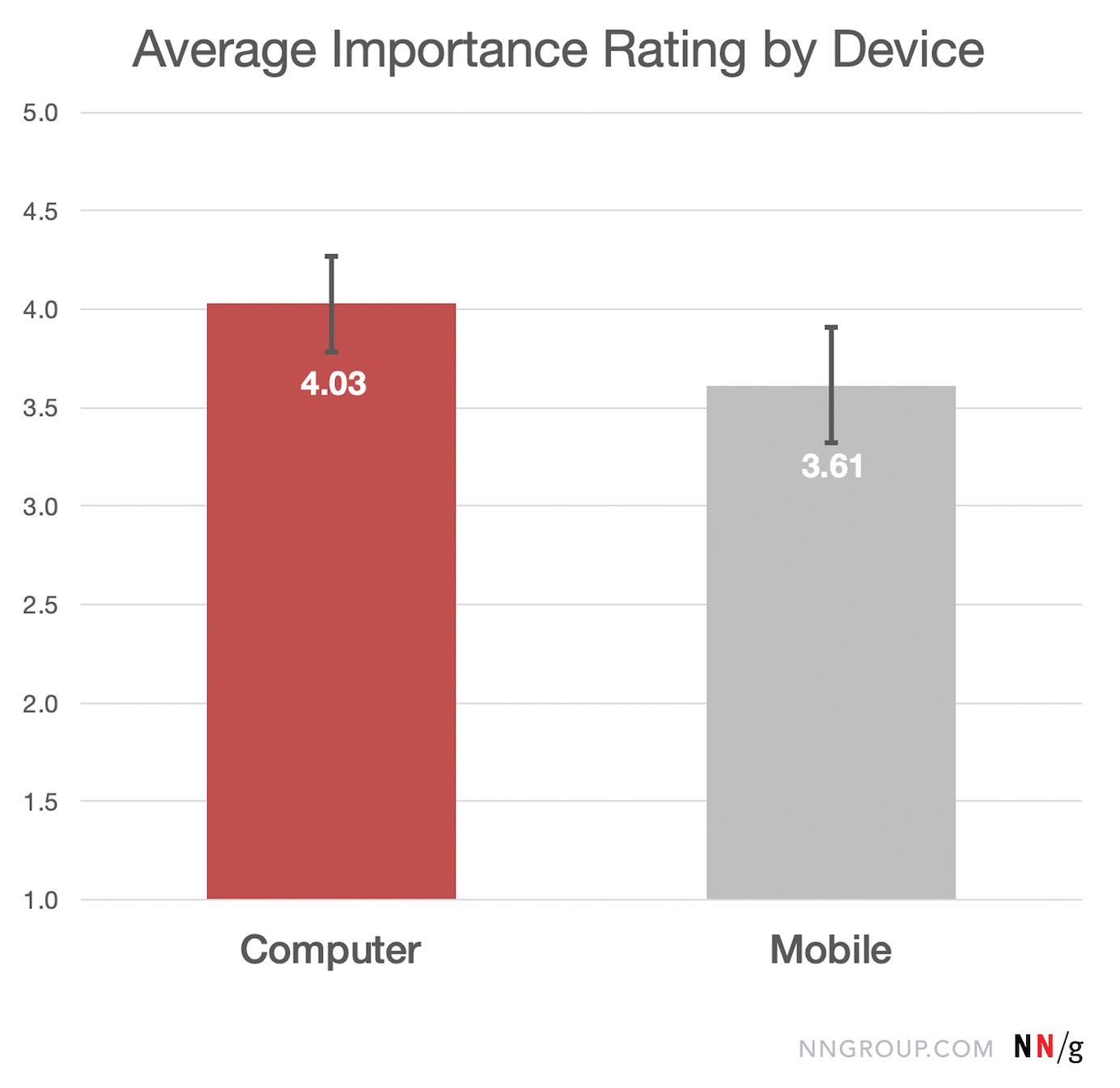
Large Devices Preferred for Important Tasks

Since the iPhone was introduced in 2007, mobile usability has made tremendous strides:  we use our phones to do a wide variety of tasks. In fact, according to Pew Internet, in 2019 17% of Americans depended on their mobile phone as their only way to access the internet at home. Those numbers are much higher in other parts of the world such as India or China.

We know that even when people have a larger device available, they sometimes prefer to use a mobile phone instead — simply because the mobile phone is always with them and it may be more convenient to use it instead of switching devices (a phenomenon we call device inertia).

But does it mean that mobile will displace computers? Will we eventually discard big-screen devices in favor of smaller, portable ones for tasks as complex as filing taxes or writing research reports?

In this article we don’t aim to answe

Setup of an Eyetracking Study

Eyetracking Research

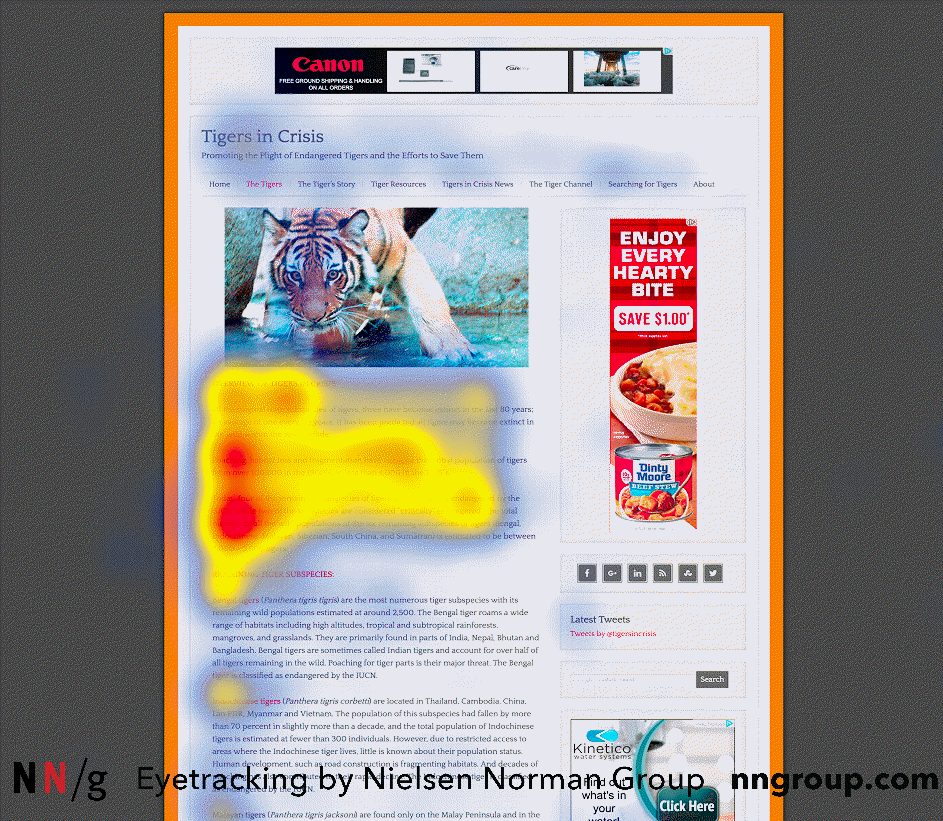
Eyetracking equipment can track and show where a person is looking. To do so, it uses a special light to create a reflection in the person’s eyes. Cameras in the tracker capture those reflections and use them to estimate the position and movement of the eyes. That data is then projected onto the UI, resulting in a visualization of where the participant looked.

This research can produce three types of visualizations:

  • Gazeplots (qualitative)
  • Gaze replays (qualitative)
  • Heatmaps (quantitative)

Setup of an Eyetracking Study This gaze plot shows how one participant processed a web page in a f

These Are The Concerns Slowly Killing Ad-Tech

Black Mirror, recently bought by Netflix, is a hugely popular TV series that is a dark, twisted but spot-on portrayal of the possible ramifications of technology in the future. Advertisements for the show are ironically targeting ad block users, and some argue, are “intentionally creepy.” For better or worse, ad tech is an industry that somehow finds itself embroiled in controversy. Ad blocking was the controversy du jour, until recently when ad blocking rates have leveled out or even dropped. Ad tech’s explosion in recent years, due to the overwhelming user demand for free digital content, has caused the mighty backlash of ad blocking.

Ad tech executives are finally taking a breath after ad blocking has stabilized, yet another monster (or two) have been slowly eating away at the industry: ad fraud and transparency issues.

The International Advertising Bureau (IAB) estimates the economic cost of ad fraud to be around $8.2 billion annually

The Key IoT Security Questions You Need To Ask

An Internet of Things (IoT) solution offers a multitude of business benefits from decreased operational costs to new revenue streams. But it also comes with a host of security considerations, including an ever-changing array of regulatory compliance requirements, demanding expert navigation and acute attention to detail.

Below I’ve listed some of the critical questions to ask when deploying a secure IoT solution. To learn more about IoT security, be sure to register for the IoT in Action event in San Francisco on February 13.

How secure are your things?

For starters, the actual devices must be secure. In the next few years, a new wave of innovation will drive down costs and inundate the market with internet-connected devices in every price range, from electronic toys to manufacturing sensors. In anticipation of this, my Microsoft colleagues have identified The seven properties of highly secure devices. I have listed o

Cybersecurity in IoT: Achieving Digital Security in an Age of Surveillance

In the 2006 science fiction thriller Déjá Vu, Denzel Washington plays a government agent who uses novel government technology to fold time and space back onto itself so that he can retroactively prevent a terrorist attack. It’s a creative interpretation of the concept of déjà vu, and, of course, Washington’s character uses this technology only for good. While the idea of literally bending time and space to repeat the past is relegated to science fiction, the film raises important questions about the ethics and prevalence of government surveillance, which are particularly prescient for our modern times.

As part of the natural evolution of technology, the internet of things (IoT) has established itself as one of the most transformative innovations of our time. IoT is a simple process of connect

Internet of Warnings: How Smart Technology Can Threaten Your Business’s Security

Science fiction technology may not be as far off as we believe. The Internet of Things (IoT) uses the powerful combination of Wi-Fi and cloud technology to send information and perform actions through devices with Internet capabilities. This advance stems from the use of telemetry, decades-old machine-to-machine communication via wired sensors and transmitters. Now the wires have been replaced by radio waves that transfer a nearly infinite amount of data.

IoT technology ranges from entire smart cities that streamline traffic to fridges that detect when you’re low on milk and order it for you, among many other products and services. Devices such as Fitbit and Nest are growing in popularity due to their low price, practicality, and variety of automatic functions. Nearly any object you use regularly can be exchanged for a “smart” version that logs usage, performs tasks for you, or learns your schedule and changes the environment accordingly—rapid

Why AI and Viztech hold the key to a safer internet

Online media companies are chasing their tails when it comes to policing terrorist material, and other dangerous and offensive content. But there is artificial intelligence-based technology out there that can spot it before it goes live, says David Fulton, CEO of WeSee.

Leading figures in both government and academia have been focused on a common cause in recent months – how best to solve the growing problem of online terrorist content. However, the jury’s out on whether the big digital media players, like Facebook, Twitter and YouTube, are up to the job, despite being under growing pressure from pending legislation. The good news it looks like a powerful new image-recognition technology based on deep learning and neural networks could provide a solution.

In the same week in June that German lawmakers passed a bill forcing major internet companies to banish “evidently illegal” content within 24 hours or face fines up to $57 mill

How tweaks to IoT’s supply chain can close security gaps

When it comes to the Internet of Things, traditional cybersecurity approaches are difficult to integrate and can’t keep operational devices secure. Many embedded device approaches isolate systems, offering only partial protection, and only against known attack vectors. Could all of our IoT security issues be resolved through a simple tweak to the supply chain?

In my mind, yes, if we start thinking about it as the IoT Supply Chain of Trust. The IoT Security Foundation coined the idea in May 2016, that IoT security has no single owner and all vendors are have a duty to care for their direct customers and the wider ecosystem.

Let’s think about it in a slightly more practical manner. If you are a manufacturer, the Supply Chain of Trust is knowing from where you’re sourcing software or hardware and understanding the security inside of whatever it is you’re sourcing. It boils down to taking ownership for each layer of security.

Создайте подобный сайт на WordPress.com
Начало работы